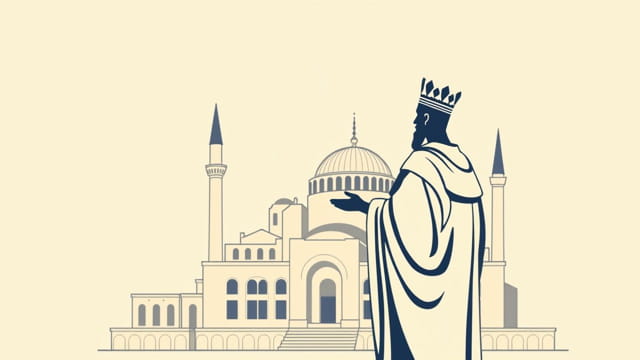
In the heart of Constantinople, modern-day Istanbul, stands one of the most magnificent architectural wonders of the ancient world the Hagia Sophia. This grand structure, with its towering dome and elaborate design, is more than a building; it is a symbol of power, faith, and imperial ambition. The question of whether Emperor Justinian I built the Hagia Sophia is often asked, especially when exploring the legacy of the Byzantine Empire. The truth is that while earlier churches with the same name existed, the Hagia Sophia as it is known today was indeed commissioned and completed under the rule of Justinian. His involvement was not merely symbolic; he played a crucial role in its conception, funding, and eventual completion.
Historical Context of Justinian’s Reign
The Byzantine Empire in the 6th Century
Justinian I reigned from 527 to 565 AD and is often regarded as one of the greatest Byzantine emperors. His era was marked by military expansion, legal reform, and monumental architecture. A devout Christian and a strong advocate of imperial authority, Justinian sought to restore the grandeur of the Roman Empire in the East. His reign was a turning point in Byzantine history, with religious and political tensions shaping much of his rule.
The Nika Riots and the Destruction of the Previous Church
Before Justinian’s Hagia Sophia was constructed, two previous churches with the same name had occupied the site. The first, built by Emperor Constantius II in 360, was destroyed during riots. The second, constructed by Emperor Theodosius II in 415, was burned down during the Nika Riots in 532. These riots, sparked by political and social unrest, nearly cost Justinian his throne. However, after restoring order, he seized the opportunity to erect a new and even grander Hagia Sophia one that would symbolize the renewed strength and divine favor of his empire.
Commissioning the Hagia Sophia
Justinian’s Vision
Justinian envisioned the Hagia Sophia not just as a place of worship, but as a lasting symbol of his rule and piety. According to historical accounts, including those of the historian Procopius, Justinian was personally invested in the project. He spared no expense and demanded that the structure surpass all others in beauty and scale. His vision was to create a church worthy of both God and the Byzantine Empire.
Architects and Design
To bring his vision to life, Justinian appointed two of the most renowned architects of the time: Anthemius of Tralles and Isidore of Miletus. These men were not traditional architects but rather mathematicians and engineers, which allowed them to approach the construction with a unique and innovative mindset. Their design featured a massive central dome, which would become the most iconic element of the Hagia Sophia.
Construction of the Hagia Sophia
Innovative Engineering
The construction of the Hagia Sophia began in 532 and was completed in just under six years, an impressive feat for a structure of its scale and complexity. The architects employed advanced engineering techniques, such as pendentives, to support the vast dome. This allowed the dome to appear as if it were floating above the central nave, a revolutionary concept at the time.
Materials and Labor
Materials were sourced from across the empire, including columns from the Temple of Artemis in Ephesus and marble from distant quarries. Thousands of workers were employed, including skilled artisans and laborers. The emperor himself reportedly visited the construction site regularly, overseeing the progress and encouraging the workers. Such involvement underscores Justinian’s deep commitment to the project.
Completion and Dedication
The Hagia Sophia was completed in 537 AD and dedicated on December 27 of that year. At the inauguration, Justinian is said to have exclaimed, Solomon, I have outdone thee! a bold statement reflecting his belief that the Hagia Sophia surpassed the Temple of Solomon in Jerusalem in splendor. The church quickly became the central place of worship in Constantinople and the religious heart of the Eastern Orthodox Church.
Architectural and Cultural Significance
A Marvel of Byzantine Architecture
The Hagia Sophia’s architectural style blended Roman engineering with Eastern ornamental detail, creating a unique Byzantine aesthetic. The vast dome, intricate mosaics, and massive scale influenced church architecture for centuries. It became a blueprint for Eastern Orthodox churches and even inspired the design of later Islamic mosques after the Ottoman conquest of Constantinople.
Religious and Political Symbolism
Beyond its architectural innovation, the Hagia Sophia served as a potent symbol of the divine authority of the emperor. It represented the unity of church and state under Justinian’s rule. Its construction demonstrated the emperor’s control over both the spiritual and temporal realms, reinforcing the notion of caesaropapism the belief that the emperor held both secular and religious power.
Legacy of Justinian and the Hagia Sophia
Conversion and Preservation
After the fall of Constantinople in 1453, the Hagia Sophia was converted into a mosque by the Ottoman Empire. Later, in the 20th century, it became a museum under the Republic of Turkey, and in 2020 it was re-designated as a mosque. Despite these changes, the building has retained much of its original design and continues to be a cultural and religious landmark.
Justinian’s Enduring Influence
Justinian’s contribution to the construction of the Hagia Sophia has endured through the centuries. His decision to build a new, magnificent church following the destruction of the previous one showcases his ambition, resilience, and dedication to the empire’s glory. The Hagia Sophia remains a testament to his legacy, reflecting both his personal devotion and his imperial vision.
Yes, Justinian did build the Hagia Sophia at least the iconic version that stands today. While he did not physically lay the bricks or draw the blueprints himself, the church was constructed under his direction, with his vision, authority, and resources. His leadership in commissioning and overseeing the project makes him the undisputed patron of the Hagia Sophia. The structure remains one of the most enduring and significant achievements of his reign, illustrating not only the heights of Byzantine architecture but also the deep intertwining of politics, religion, and art in the ancient world. Through the Hagia Sophia, Justinian’s name continues to be remembered as a builder of empires both in stone and in spirit.