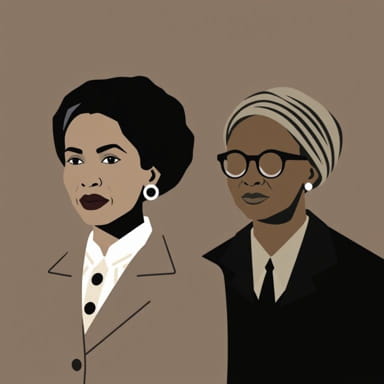
Throughout American history, few names stand out as boldly as Rosa Parks and Harriet Tubman. These two women, separated by nearly a century, are united by their unwavering courage and determination to fight against racial injustice. While their methods and contexts differed, both became iconic symbols of resistance and freedom in the long struggle for civil rights in the United States. Their stories continue to inspire new generations in the ongoing pursuit of equality and human dignity.
Harriet Tubman: The Moses of Her People
Early Life and Escape from Slavery
Harriet Tubman was born into slavery around 1822 in Dorchester County, Maryland. Her birth name was Araminta Ross, but she later changed it to Harriet in honor of her mother. From a young age, she experienced the brutal realities of slavery, including physical violence and the traumatic separation of families. In 1849, Tubman made a daring escape to freedom in the North, leaving behind her enslaved life and vowing to help others do the same.
Conductor of the Underground Railroad
Harriet Tubman is best known for her work as a conductor on the Underground Railroad, a secret network of safe houses and routes that helped enslaved African Americans escape to free states and Canada. Tubman risked her life repeatedly, making at least 13 missions and helping over 70 people find freedom. Her courage and leadership earned her the nickname ‘Moses,’ referencing the biblical figure who led his people out of slavery.
Role in the Civil War
During the American Civil War, Tubman continued her fight for freedom by serving as a spy, nurse, and cook for the Union Army. She became the first African American woman to lead a military expedition, guiding the Combahee River Raid in South Carolina, which liberated over 700 slaves. Her contribution to the war effort further solidified her status as a national hero.
Later Life and Advocacy
After the war, Harriet Tubman settled in Auburn, New York, where she continued to advocate for civil rights and women’s suffrage. She worked alongside prominent activists like Susan B. Anthony and supported the movement for equal rights for all. Tubman died in 1913, leaving behind a powerful legacy of resistance and hope.
Rosa Parks: Mother of the Civil Rights Movement
Background and Early Activism
Rosa Parks was born in 1913 in Tuskegee, Alabama. Raised in a segregated society, she became acutely aware of racial injustice from an early age. She joined the Montgomery chapter of the NAACP (National Association for the Advancement of Colored People) in the 1940s and worked as a secretary, quietly building a foundation for her future role in the civil rights movement.
The Montgomery Bus Boycott
Rosa Parks became an international figure on December 1, 1955, when she refused to give up her seat to a white passenger on a segregated bus in Montgomery, Alabama. Her arrest sparked the Montgomery Bus Boycott, a 381-day protest against racial segregation on public buses. Led by Dr. Martin Luther King Jr., the boycott became a turning point in the American civil rights movement, ultimately leading to a Supreme Court decision declaring bus segregation unconstitutional.
Continued Activism and Recognition
Following the boycott, Rosa Parks continued her activism by working for Congressman John Conyers in Detroit and participating in numerous civil rights events. She remained committed to justice throughout her life, advocating for political prisoners, voting rights, and social equality. Parks received numerous honors, including the Presidential Medal of Freedom and the Congressional Gold Medal.
Comparing Their Contributions
Different Eras, Shared Struggle
Although Harriet Tubman and Rosa Parks lived in different centuries and faced different forms of racial injustice, their resistance contributed to the same overarching goal: freedom and equality for African Americans. Tubman fought against slavery in a pre-Civil War society, while Parks challenged Jim Crow laws in the mid-20th century. Both women showed extraordinary courage in confronting systems of oppression.
Legacy of Leadership
The legacy of Harriet Tubman and Rosa Parks extends far beyond their lifetimes. They are remembered not just for their individual acts of defiance, but for their broader impact on social justice movements. Their stories are taught in schools, commemorated in art and literature, and honored through monuments and public buildings. Each woman has become a lasting symbol of what it means to stand up against injustice, even when the cost is great.
Inspiring Future Generations
Harriet Tubman and Rosa Parks continue to inspire activists, educators, and everyday citizens. Their lives remind us that ordinary individuals can spark extraordinary change. From grassroots organizing to national advocacy, their influence can be seen in the ongoing efforts for racial justice, women’s rights, and community empowerment across the globe.
Impact on Civil Rights in America
Shaping the National Consciousness
The stories of these two iconic women have helped shape the American national consciousness. Harriet Tubman’s efforts challenged the institution of slavery and inspired abolitionist movements, while Rosa Parks ignited a broader movement that led to the Civil Rights Act of 1964 and the Voting Rights Act of 1965. Their courage helped to awaken a moral reckoning that continues to influence public policy and cultural understanding.
Honoring Their Memory
Both Harriet Tubman and Rosa Parks have been commemorated in numerous ways. Tubman’s image has been proposed for the U.S. twenty-dollar bill, while Parks has schools, libraries, and museums named in her honor. These tributes are not just historical acknowledgments; they serve as reminders that the fight for justice requires resilience, conviction, and a willingness to confront injustice at every turn.
- Harriet Tubman helped free over 70 slaves via the Underground Railroad
- Rosa Parks’ defiance led to the Montgomery Bus Boycott
- Both were honored with national medals and memorials
- They remain powerful symbols of freedom and justice
Rosa Parks and Harriet Tubman were more than just participants in history they were architects of change. Each woman, through her bold actions and unwavering principles, challenged the structures of oppression and helped transform America. Their legacies serve as testaments to the power of individual courage and the importance of collective action. In remembering them, we are reminded of the work still to be done, and the enduring truth that resistance to injustice is the path to liberation.