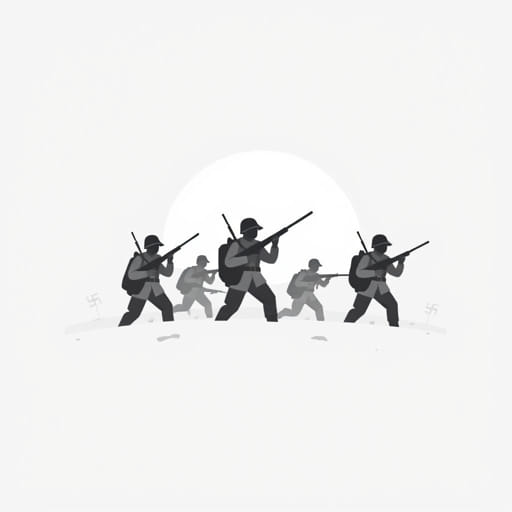
In the final months of World War II, the Wehrmacht, once a powerful and disciplined military force of Nazi Germany, was brought to its knees. Under relentless pressure from the Allies in the west and the Red Army in the east, Germany’s last hope of turning the tide crumbled. Yet, even in the face of near-certain defeat, the Wehrmacht continued to resist, staging its final defense across the shattered remnants of the Reich. The last stand of the Wehrmacht is not only a story of military desperation, but also one of political delusion, immense human suffering, and the tragic cost of war.
The Decline of the Wehrmacht
The Situation in Early 1945
By early 1945, the German war machine had been pushed back on all fronts. The Wehrmacht, which had once blitzed its way across Europe, was now outmatched and outnumbered. Hitler’s refusal to allow strategic withdrawals or to recognize military realities led to catastrophic losses. The Battle of the Bulge had failed in the west, while the Red Army had broken through into Poland and the outskirts of Berlin. Germany’s industrial heartland had been bombed into ruin, and morale was collapsing.
Manpower Shortages and Youth Conscription
The Wehrmacht faced severe manpower shortages. The once professional army was now filled with teenage conscripts, old men from the Volkssturm (the national militia), and wounded veterans recycled from hospitals. Training was minimal, equipment was outdated or in short supply, and many units operated without proper supplies or communications. Still, Nazi propaganda pushed the idea of victory through sacrifice, urging the people and soldiers to fight to the bitter end.
Eastern Front: A Brutal Collapse
The Red Army’s Push into Germany
On the Eastern Front, the Red Army launched the Vistula-Oder Offensive in January 1945, moving hundreds of kilometers in mere weeks. Soviet forces, hardened by years of brutal fighting and bolstered by vast manpower and equipment, overwhelmed German defenders. Cities like Königsberg and Breslau were encircled and besieged. Civilians fled in panic as tales of Soviet retribution spread. The Wehrmacht, unable to counter the speed and scale of the offensive, fell back in disorganized retreats.
The Battle of Berlin
The final battle for Berlin in April 1945 was the ultimate symbol of the Wehrmacht’s last stand. Although the city was defenseless in any strategic sense, Hitler demanded it be held at all costs. Wehrmacht units, SS troops, and the Volkssturm fought street by street. Artillery bombardments turned entire districts to rubble. Despite their efforts, the outcome was inevitable. On May 2, 1945, Berlin fell, and shortly after, the German High Command surrendered.
Western Front: Delay and Desperation
Defending the Rhine
In the west, Allied forces crossed the Rhine in March 1945 after capturing the Ludendorff Bridge at Remagen. The Wehrmacht attempted to delay their advance through small-scale counterattacks and demolitions, but the Allies’ momentum was unstoppable. Despite isolated acts of resistance, German forces were quickly swept aside. Cities such as Cologne, Frankfurt, and Nuremberg fell one after the other. German troops increasingly surrendered en masse, recognizing the futility of further fighting.
The Ruhr Pocket and Final Resistance
The Ruhr Pocket was one of the last significant engagements of the Wehrmacht. Surrounded by American forces, over 300,000 German soldiers were encircled. Hitler ordered them to hold the line, but without adequate supplies or hope of relief, their resistance quickly dissolved. This encirclement marked the collapse of Germany’s industrial military production and symbolized the futility of continuing the war.
Internal Disintegration
Fragmented Command Structure
As the war drew to a close, the Wehrmacht’s chain of command disintegrated. Communications broke down, regional commanders acted independently, and some even attempted to negotiate separate peace deals. The traditional Prussian officer corps, already marginalized by Nazi ideology, lost its influence. Hitler’s paranoia and delusions made meaningful coordination impossible.
Role of the SS and Fanaticism
While many Wehrmacht officers sought to end the war, the SS and Nazi loyalists enforced a policy of no surrender. Execution squads punished retreat or surrender. Fanatical SS units continued to resist even after German military leaders had accepted defeat. This internal conflict further weakened the effectiveness of the Wehrmacht’s final operations.
The Surrender and Legacy
The German Capitulation
On May 7, 1945, General Alfred Jodl signed the unconditional surrender of all German forces in Reims, France. A second formal signing took place on May 8 in Berlin with Soviet representatives present. This date became known as Victory in Europe (VE) Day. The Wehrmacht, as an organized force, ceased to exist. Germany was divided and occupied, and the military leadership was arrested.
Postwar Reckoning and Denazification
After the war, the Wehrmacht’s role in Nazi crimes came under scrutiny. Though initially portrayed as a professional force distinct from the SS, later evidence revealed the Wehrmacht’s complicity in war crimes, especially on the Eastern Front. Mass shootings, support for the Holocaust, and brutal anti-partisan campaigns were part of its record. The process of denazification aimed to dismantle the military structures and ideologies that sustained the regime.
A Symbol of Tragedy and Consequence
The Wehrmacht’s last stand represents a powerful moment in the history of World War II a combination of blind loyalty, military tradition, and the tragic unwillingness to surrender. It showed how a once-formidable force could be destroyed by the very ideologies it served. The human cost was immense, and the legacy left behind continues to shape historical memory in Germany and around the world. In remembering the Wehrmacht’s final days, one must also remember the millions of lives lost, the cities destroyed, and the lessons learned from the consequences of total war.