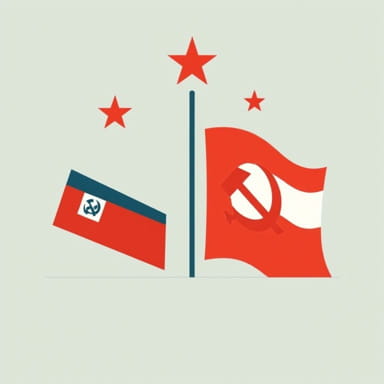
Throughout the Cold War, one of the defining and most controversial strategies pursued by the Soviet Union was its policy of expansionism. Emerging from the ruins of World War II, the USSR sought to extend its ideological, political, and military influence across Eastern Europe, Asia, Africa, and even Latin America. This expansionism was not merely about geographic growth; it represented a direct challenge to the Western capitalist world led by the United States. The fear of communist domination drove many international policies, alliances, and even conflicts for decades. The term Soviet expansionism became a central theme in Cold War rhetoric, reflecting the global struggle for dominance between two superpowers with competing worldviews.
Origins of Soviet Expansionism
Ideological Foundations
Soviet expansionism was rooted in Marxist-Leninist ideology. According to Marxist thought, global revolution was inevitable, and capitalism would eventually be overthrown by the working class. Lenin expanded on this by emphasizing the need for a vanguard party to lead the revolution and for socialism to spread beyond borders. This ideological commitment to spreading communism shaped Soviet foreign policy from the very beginning.
Post-World War II Power Vacuum
After World War II, many countries in Europe were devastated and politically unstable. The Soviet Union, having borne enormous losses, was determined to secure its western borders from any future threat. As a result, it quickly moved to establish influence in Eastern European countries, many of which had been liberated from Nazi control by the Red Army. These areas were soon drawn into the Soviet sphere of influence.
The Iron Curtain and Eastern Bloc
Creation of Satellite States
By the late 1940s, several Eastern European nations had fallen under Soviet control. These included Poland, East Germany, Hungary, Romania, Bulgaria, and Czechoslovakia. The Soviet Union either installed or supported communist regimes in these nations, effectively creating a buffer zone of loyal states. These countries were often referred to as satellite states. Their economies, military strategies, and internal policies were closely aligned with Moscow’s directives.
Suppression of Dissent
To maintain control, the Soviet Union often intervened directly when communist rule was threatened. In 1956, Soviet tanks crushed the Hungarian Uprising. Similarly, in 1968, the Prague Spring in Czechoslovakia was ended by Warsaw Pact troops. These events revealed the Soviet Union’s determination to retain control over its satellite states at all costs, reinforcing the image of aggressive Soviet expansionism.
Global Spread of Influence
Asia and the Korean War
Soviet expansionist ambitions were not limited to Europe. In Asia, the Soviet Union supported the establishment of communist regimes. It aided North Korea, which invaded South Korea in 1950, triggering the Korean War. Though the Soviet Union did not send troops directly, it provided critical weapons and support to the North, demonstrating its willingness to expand influence through proxies.
Support in the Vietnam War
The Vietnam War also illustrates Soviet expansionism. The USSR backed North Vietnam with military aid, advisors, and equipment. Its goal was to ensure that communism prevailed in Southeast Asia, extending the ideological battlefront of the Cold War far beyond Europe.
Latin America and Africa
In the 1960s and 70s, Soviet expansionist policy reached Latin America and Africa. The most famous case was Cuba. After Fidel Castro came to power in 1959, Cuba aligned with the USSR, culminating in the Cuban Missile Crisis of 1962. In Africa, the Soviet Union supported liberation movements and socialist governments in Angola, Mozambique, and Ethiopia, among others. These engagements showed the global scope of Soviet foreign policy ambitions.
Military Alliances and Arms Race
Formation of the Warsaw Pact
In response to NATO, the Soviet Union established the Warsaw Pact in 1955. This military alliance united Eastern Bloc countries under a single defense agreement. Though presented as a collective security measure, in practice, it reinforced Soviet control over its allies and allowed Moscow to maintain military presence in member states.
Arms Race and Deterrence
Soviet expansionism also played out in the arms race. The USSR developed nuclear weapons and expanded its arsenal to counter the United States. The resulting doctrine of Mutually Assured Destruction (MAD) was meant to deter either side from launching a first strike. However, the buildup of weapons and deployment of Soviet missiles in regions like Cuba underscored the aggressiveness of Soviet policy.
Economic Expansion and COMECON
Beyond military and political influence, the Soviet Union sought to expand its control through economic means. In 1949, it established the Council for Mutual Economic Assistance (COMECON). This organization tied the economies of Eastern Bloc nations to the Soviet model. While it aimed to promote cooperation, it also ensured economic dependence on Moscow, further consolidating Soviet power.
Ideological Battles and Propaganda
Soviet expansionism was not only fought on the battlefield or in politics; it was a war of ideas. The USSR invested heavily in propaganda, both domestically and internationally. It portrayed the Soviet model as a path to equality and justice, in contrast to what it framed as the imperialism and exploitation of the West. Radio broadcasts, literature, education, and cultural exchanges were used to influence foreign populations, particularly in the developing world.
Western Response and Containment
Truman Doctrine and Marshall Plan
The Western powers, especially the United States, responded to Soviet expansionism with the policy of containment. The Truman Doctrine pledged support to countries resisting communism, while the Marshall Plan provided economic aid to rebuild Western Europe and prevent the spread of communist influence. These policies were fundamental to the West’s strategy of curbing Soviet power.
Proxy Wars and Intelligence Operations
The Cold War saw numerous proxy wars where the US and USSR backed opposing sides. In addition to Korea and Vietnam, conflicts in Afghanistan, Latin America, and Africa bore the marks of this global rivalry. Intelligence agencies like the CIA and KGB were heavily involved in covert operations designed to support friendly regimes or destabilize opponents.
Decline of Soviet Expansionism
Afghanistan and Overreach
The Soviet invasion of Afghanistan in 1979 marked the beginning of the end for Soviet expansionism. Intended to prop up a communist government, the war dragged on for nearly a decade, costing the USSR dearly in lives, money, and reputation. It became known as the Soviet Vietnam, and highlighted the limits of Soviet power.
Gorbachev and Policy Shift
In the 1980s, Mikhail Gorbachev introduced reforms like Glasnost and Perestroika, which aimed to revitalize the Soviet system. He also shifted foreign policy by reducing military engagements and loosening control over Eastern Europe. This led to a wave of revolutions in 1989, culminating in the fall of the Berlin Wall and the collapse of communist regimes across the Eastern Bloc.
End of the Cold War
By 1991, the Soviet Union itself dissolved, effectively ending the era of Soviet expansionism. The Cold War was over, and with it, the ideological drive to spread communism through state power. The legacy of Soviet expansionism, however, continues to influence global geopolitics and historical memory.
Soviet expansionism during the Cold War was a defining force in 20th-century international relations. Driven by ideology, national security, and a desire for global influence, the USSR extended its reach across the globe. This expansion was met with resistance from the West, leading to decades of tension, conflict, and fear. Although the Soviet Union no longer exists, the consequences of its expansionist policies are still felt today in former satellite states, ongoing geopolitical rivalries, and historical narratives that continue to shape our understanding of power, ideology, and resistance.
#kebawah#