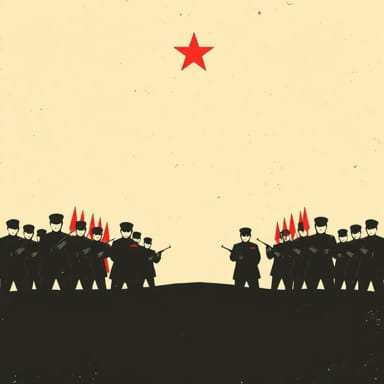
The Cold War has inspired intense historical debate, and one of the most influential shifts in its interpretation came with the rise of post-revisionist thought. Unlike traditional or revisionist scholars, post-revisionists took a more balanced approach, aiming to understand the complexity of the conflict between the United States and the Soviet Union. Historians in this category emphasized the mutual misunderstandings, domestic pressures, and systemic factors that fueled the decades-long geopolitical struggle. To understand the essence of post-revisionist Cold War analysis, it is valuable to explore not only its themes but also some of the most insightful post-revisionist Cold War quotes that continue to shape academic discussion and public understanding.
Understanding Post-Revisionist Historiography
What Is Post-Revisionism?
Post-revisionism emerged in the late 1970s and early 1980s as a response to both the traditionalist view, which blamed the Soviet Union for the Cold War, and the revisionist perspective, which placed the blame on American imperialism. Post-revisionist historians argue that the Cold War was the result of a complex set of circumstances where neither side held full responsibility. Instead, they highlight the misunderstandings, mutual suspicions, and security concerns that were intrinsic to the superpowers’ actions.
Key Themes of Post-Revisionist Thought
- Emphasis on shared responsibility for the Cold War.
- Focus on structural causes such as power vacuums, economic systems, and military competition.
- Understanding of miscommunication and mistrust as central to escalating tensions.
- Interest in domestic influences on foreign policy decisions in both the United States and the USSR.
Important Post-Revisionist Historians
John Lewis Gaddis
One of the most influential post-revisionist historians, John Lewis Gaddis, sought to provide a more objective and nuanced understanding of Cold War diplomacy. His work analyzes how ideological differences and geopolitical realities both played a role in shaping the global conflict.
Melvyn P. Leffler
Another major post-revisionist voice, Melvyn P. Leffler, focused on the role of U.S. national security and internal fears. His scholarship stressed how American leaders acted not merely out of aggression but also from a deep concern over maintaining a favorable global balance.
Post-Revisionist Cold War Quotes and Their Significance
John Lewis Gaddis
Neither side can bear sole responsibility for the onset of the Cold War; it was the product of mutual distrust, ideological incompatibility, and conflicting strategic interests.
This quote from Gaddis perfectly encapsulates the post-revisionist viewpoint. Instead of assigning blame, it points to a complex interplay of fears, ideologies, and global strategies that pushed both superpowers into confrontation.
Melvyn P. Leffler
The United States, in the name of defending democracy, often pursued strategies grounded in economic and security imperatives, rather than pure ideological expansion.
Leffler’s perspective shows that American policy during the Cold War was influenced heavily by domestic considerations and geopolitical calculations, not just a desire to spread democracy or capitalism.
Odd Arne Westad
The Cold War was not simply a bipolar confrontation it was a global phenomenon, shaped by decolonization, nationalism, and local conflicts.
This quote extends the post-revisionist argument beyond Europe and North America, highlighting how the Cold War affected and was influenced by the Global South. Post-revisionists often emphasize that the superpower rivalry played out differently across regions.
Marc Trachtenberg
Security, not ideology, was the driving force of early Cold War policies. Both sides reacted to perceived threats rather than seeking confrontation.
Trachtenberg’s analysis helps us understand the importance of perceived threats and national security in the decision-making processes of both the U.S. and USSR. This aligns with the post-revisionist focus on mutual insecurity rather than ideological offensives.
Broader Implications of Post-Revisionist Thought
Challenging Simplistic Narratives
Post-revisionism challenges the idea that one side was purely aggressive while the other was defensive. By analyzing both sides’ motivations, it offers a richer understanding of how and why the Cold War unfolded the way it did.
Influence on Modern Policy Thinking
Post-revisionist insights are not only relevant to historians they also influence how current policymakers think about international conflict. The understanding that miscommunication, mutual suspicion, and domestic politics can all contribute to conflict helps in shaping more nuanced diplomacy today.
Use in Education
Post-revisionist Cold War quotes and perspectives are widely used in academic curricula, encouraging students to think critically about history. Instead of accepting a single narrative, learners are taught to evaluate multiple factors and viewpoints.
Legacy of the Post-Revisionist Movement
Continuing Relevance
Although the Cold War ended in the early 1990s, the post-revisionist approach continues to influence historical scholarship and public discourse. The movement reminds us that history is rarely black and white and that complex global events deserve careful, balanced examination.
Limitations and Criticism
While post-revisionism has been widely praised, it has also been critiqued for being too neutral or for underplaying moments of clear aggression by one side. Critics argue that in trying to be balanced, post-revisionists may overlook genuine injustices or oppressive actions, particularly those committed by authoritarian regimes.
A Balanced Framework
Post-revisionist Cold War quotes serve as valuable tools for understanding one of the most critical periods in modern history. Rather than reducing the Cold War to a simple tale of good versus evil, post-revisionist scholars focus on deeper structural causes, misjudgments, and unintended consequences. Historians like John Lewis Gaddis, Melvyn P. Leffler, and Odd Arne Westad show how the conflict was shaped not only by ideology but also by fear, ambition, and uncertainty. These insights continue to shape how we view not only the past but also the present and future of global politics.