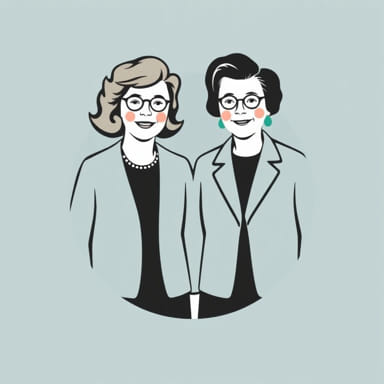
Phyllis Schlafly and Betty Friedan were two towering figures in the American women’s movement, yet they stood on opposite sides of a deeply divisive cultural and political battlefield. Their ideologies, writings, and activism not only influenced public discourse but also reflected the complex debates around gender roles, feminism, and family values in 20th-century America. Understanding the lives and legacies of these two women is essential for anyone exploring the evolution of women’s rights, conservative activism, and feminist theory. While Betty Friedan fought passionately for the Equal Rights Amendment and women’s liberation, Phyllis Schlafly mobilized conservative women to oppose those very goals, advocating instead for traditional family structures and national sovereignty.
Background and Early Influences
Betty Friedan: A Voice for Modern Feminism
Betty Friedan was born in 1921 in Peoria, Illinois. She pursued higher education at Smith College and later studied psychology at the University of California, Berkeley. Her early experiences, including workplace discrimination and domestic dissatisfaction, led her to question traditional gender roles. These experiences culminated in the publication of her groundbreaking book,The Feminine Mystique, in 1963. The book identified what she called ‘the problem that has no name,’ referring to the widespread unhappiness of suburban housewives despite living in material comfort.
The Feminine Mystiquebecame a best-seller and helped ignite the second wave of feminism in the United States. Friedan argued that women should not be confined to domestic life and that fulfillment could be found through education, careers, and personal growth. She soon became a co-founder and the first president of the National Organization for Women (NOW), which aimed to bring women into full participation in American society.
Phyllis Schlafly: Defender of Traditional Values
Phyllis Schlafly, born in 1924 in St. Louis, Missouri, was an articulate and well-educated woman who earned a law degree while raising six children. A staunch conservative, she gained national attention through her work in national defense and conservative politics, writing the influential bookA Choice Not an Echoin 1964. Schlafly viewed feminism as a threat to traditional family values and the natural differences between men and women.
Unlike Friedan, Schlafly believed that a woman’s highest achievements could be found in marriage, motherhood, and homemaking. Her activism surged in the 1970s as she launched the STOP ERA campaign, a grassroots movement dedicated to defeating the Equal Rights Amendment. Her ability to mobilize conservative women reshaped the debate and contributed significantly to the ERA’s failure to be ratified by the required number of states.
The Equal Rights Amendment: A Defining Battle
The ERA was first introduced in Congress in 1923 but gained momentum in the 1970s. It aimed to eliminate legal distinctions between men and women regarding divorce, property, employment, and other matters. Betty Friedan saw the ERA as a vital step toward full legal equality for women. She lobbied intensively, organized protests, and worked through NOW to build political support.
In sharp contrast, Phyllis Schlafly warned that the ERA would dismantle protections for housewives, lead to women being drafted into the military, and undermine the family unit. Through pamphlets, speeches, and televised debates, Schlafly argued that the amendment was unnecessary and harmful. Her grassroots activism led to delays in ratification, and despite passing both houses of Congress in 1972, the amendment ultimately failed to gain approval from three-fourths of the states.
Major Arguments in the ERA Debate
- Friedan’s View: Legal equality was essential for women to have equal opportunity in education, employment, and public life.
- Schlafly’s View: Legal equality would erase traditional gender roles and harm women by removing gender-specific protections.
- Public Impact: The clash between these two figures sparked national debate and led to polarized views on feminism and family policy.
Clash of Ideologies
Friedan and Schlafly embodied opposing views not just on the ERA but on the broader meaning of feminism. Friedan believed that women should be liberated from traditional roles imposed by a male-dominated society. She criticized the media, educational institutions, and even consumer culture for perpetuating the myth that women could only find happiness through domesticity.
Schlafly, on the other hand, saw feminism as a form of social engineering that devalued motherhood and denied the natural differences between men and women. She promoted the idea that women could wield great influence within the family structure and argued that conservative women had every right to oppose feminist reforms without being labeled backward or oppressed.
Televised Debates and Public Encounters
Friedan and Schlafly often met in public debates, where they passionately argued their positions. In one famous television appearance, Friedan referred to Schlafly as an Aunt Tom, accusing her of betraying her gender. Schlafly, ever composed and strategic, responded by highlighting her credentials as a successful wife, mother, and political activist. These encounters drew wide public attention and underscored the intensity of the ideological divide.
Legacy and Cultural Impact
Betty Friedan’s Enduring Influence
Friedan’s contributions to the feminist movement continue to be recognized globally. She helped pave the way for legislative achievements such as Title IX and the legalization of abortion in Roe v. Wade. Her advocacy inspired generations of women to pursue careers and education without shame or societal restrictions. She remained a vocal figure in feminist debates well into the 1990s, constantly adapting her views to address the changing roles of women in modern society.
Phyllis Schlafly’s Conservative Revolution
Schlafly’s influence extended beyond the ERA. She played a key role in shaping the modern conservative movement and helped align evangelical Christians with Republican politics. Her work helped lay the foundation for later conservative campaigns against abortion, same-sex marriage, and secularism in public life. She founded the Eagle Forum, an organization that continues to advocate for conservative policies and family values.
- Friedan is remembered as a founding mother of modern feminism.
- Schlafly is hailed by conservatives as a protector of the American family.
- Their debate continues to echo in contemporary discussions about gender roles and women’s rights.
Phyllis Schlafly and Betty Friedan were not just individuals; they were symbols of two vastly different visions for American women. Friedan’s call for liberation and equal rights clashed with Schlafly’s defense of tradition and family structure, creating a national conversation that reshaped the political landscape. Though their paths never converged ideologically, each woman left a lasting legacy that continues to shape debates on feminism, politics, and cultural identity. Whether one agrees with Friedan’s push for equality or Schlafly’s embrace of tradition, their influence is undeniable in shaping the modern American dialogue about what it means to be a woman.