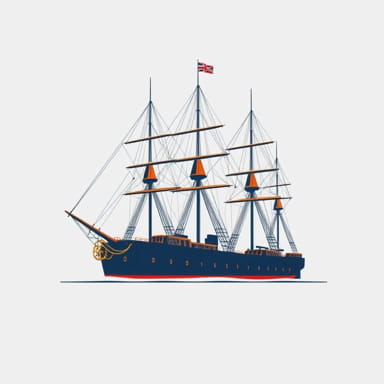
Among the many proud symbols of British naval history, one warship stands out as a living relic of centuries past HMS Victory. Still afloat and preserved as a museum ship, HMS Victory is not only the oldest British warship still in existence but also a testament to the strength, craftsmanship, and legacy of the Royal Navy. Its story spans warfare, maritime innovation, and the enduring honor associated with naval service. This vessel serves as a direct connection to the Age of Sail, when wooden ships and wind power ruled the seas. In its timbers lies a history filled with battle, leadership, and a dedication to national defense that shaped the identity of a naval superpower.
The Origins of HMS Victory
HMS Victory was ordered in 1758 during a period of intense naval expansion and was launched in 1765 at the Chatham Dockyard. Although it took nearly a decade from order to completion, the ship was constructed using over 6,000 trees, mostly oak. Designed as a first-rate ship of the line, HMS Victory was equipped with 104 guns across three gun decks, a massive vessel by 18th-century standards.
Victory was initially used in various fleet activities, but her full historic significance emerged during the Napoleonic Wars. The ship’s elegant lines, combined with her sheer firepower, made her a symbol of British naval dominance. The ship stood as a pinnacle of shipbuilding, designed not just for battle but also for command and control in the heat of naval warfare.
A Role in the American War of Independence
Before becoming famous for the Battle of Trafalgar, HMS Victory played a critical role in earlier conflicts, including the American War of Independence. In 1778, she served as the flagship of Admiral Augustus Keppel during the indecisive Battle of Ushant. Her commanding presence and enduring design kept her as a preferred choice among naval admirals throughout the 18th century.
The Battle of Trafalgar and Admiral Nelson
HMS Victory’s most defining moment came on October 21, 1805, during the Battle of Trafalgar. Under the command of Vice-Admiral Horatio Nelson, she led the British fleet into a decisive battle against the combined navies of France and Spain. Nelson’s daring tactics, including the famous order to engage the enemy more closely, were executed from Victory’s decks.
Though Admiral Nelson lost his life during the engagement, the battle ended in a stunning victory for Britain. HMS Victory was at the center of this pivotal event, solidifying its place in naval history. Her guns delivered destructive broadsides that helped secure dominance over the enemy fleets, changing the course of the Napoleonic Wars and ensuring British control of the seas for over a century.
Structural Strength and Seaworthiness
The longevity of HMS Victory is due in large part to her robust construction. The hull was built with thick oak planks, and the ship was maintained rigorously throughout her active years. She survived storms, battles, and long voyages, a testament to the skills of the shipwrights who constructed her. Unlike many wooden ships of her era that succumbed to rot or shipworm, Victory was regularly repaired and refurbished.
Despite these maintenance efforts, the toll of centuries did lead to periods of decline. At various points, the ship was in danger of deteriorating beyond repair. However, preservation campaigns and royal patronage helped ensure her survival.
Retirement and Restoration
After decades of active service, HMS Victory was retired from frontline duty. She continued to serve as a training ship and later as a stationary flagship. In the 1920s, a major campaign was launched to save the deteriorating vessel. Thanks to public donations and government support, restoration efforts began in earnest, and the ship was dry-docked at Portsmouth Historic Dockyard in southern England, where she remains today.
HMS Victory has been carefully restored to reflect her appearance during the Battle of Trafalgar. Original fittings, period-correct rigging, and authentic paint colors have been used to provide visitors with an accurate sense of what the ship was like in her prime. She is no longer seaworthy in the traditional sense but is still afloat in a specially designed cradle that supports her aging hull.
Educational and Cultural Importance
HMS Victory serves as more than just a historical artifact. She is an educational tool, offering visitors and scholars alike the chance to learn about 18th-century naval warfare, ship design, and the lives of sailors during the Age of Sail. Guided tours, exhibits, and reenactments bring her story to life for thousands of people every year.
The ship also holds ceremonial importance, often hosting visits from members of the royal family and naval officers. As the official flagship of the First Sea Lord, she continues to play a role in Royal Navy tradition and heritage.
Symbol of National Pride
As the oldest British warship still afloat, HMS Victory stands as a powerful symbol of the nation’s maritime legacy. She represents the bravery of sailors, the ingenuity of naval architects, and the importance of sea power in shaping world history. Her presence at Portsmouth is a reminder of Britain’s naval past and an inspiration for future generations.
- Launched in 1765
- Equipped with 104 guns
- Flagship at the Battle of Trafalgar in 1805
- Home port: Portsmouth Historic Dockyard
- Official flagship of the First Sea Lord
Comparison with Other Historic Warships
While many nations preserve historic naval vessels, few ships rival the age and significance of HMS Victory. In comparison, the American USS Constitution, another iconic wooden warship, was launched in 1797, decades after Victory. Although still seaworthy and regularly sailed, Constitution does not carry the same association with a globally defining battle as HMS Victory does with Trafalgar.
This distinction makes HMS Victory not only the oldest British warship still afloat but also one of the most historically impactful ships in existence. Her influence extends far beyond naval circles, reaching into national identity, education, and international heritage.
HMS Victory’s legacy as the oldest British warship still afloat is unmatched. Her story weaves through major historical conflicts, technological advancements, and national achievements. She remains a proud symbol of British resilience, leadership, and naval prowess. Visitors who step aboard this magnificent vessel are not just walking on weathered timber they are stepping into history itself. As she continues to be preserved for future generations, HMS Victory holds her place not just in the drydock of Portsmouth, but in the heart of maritime history.