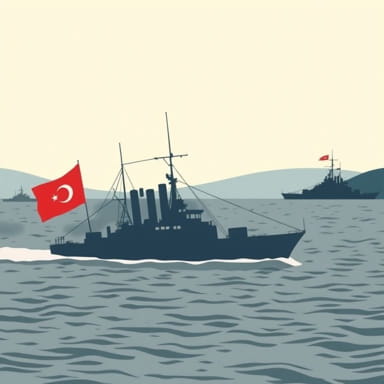
The Dardanelles Campaign, also known as the Gallipoli Campaign, was one of the most ambitious and tragic operations of World War I. Situated in the narrow straits between the Aegean Sea and the Sea of Marmara, the Dardanelles held great strategic significance. Controlling these waters meant having direct naval access to the Ottoman capital, Constantinople, and a route to support Russia. In early 1915, the Allies launched a series of naval operations in the Dardanelles, aiming to force the straits, defeat the Ottoman Empire, and open a supply route to their Eastern ally. However, the naval operations encountered unexpected resistance, logistical failures, and deadly minefields, resulting in a drawn-out and costly campaign.
Strategic Importance of the Dardanelles
The Dardanelles Strait had long been recognized as a geopolitical chokepoint. During World War I, the Allies believed that capturing it would weaken the Ottoman Empire and potentially encourage neutral Balkan states to join the war on their side. The British and French high commands hoped a successful naval strike would avoid the need for a prolonged land campaign, making the Dardanelles a primary objective early in 1915.
Goals of the Naval Campaign
The objectives of the naval operations were straightforward in theory but complex in execution:
- Penetrate the Dardanelles Strait with Allied battleships.
- Neutralize Ottoman coastal defenses through bombardment.
- Clear the minefields to allow safe passage for supporting ships.
- Reach and capture Constantinople, forcing the Ottoman Empire to surrender.
To achieve these ends, the Allied powers deployed a large fleet comprising British and French battleships, cruisers, destroyers, and minesweepers.
Early Naval Engagements
Initial operations began in February 1915 with long-range bombardments of the outer forts guarding the entrance to the strait. British ships such as HMS Queen Elizabeth and French vessels like Bouvet shelled the Turkish fortifications. The intent was to destroy artillery positions and demoralize the defenders without committing ground troops.
However, these early attacks revealed significant limitations. Naval gunfire was largely ineffective at destroying well-fortified emplacements, especially without aerial spotting. The Ottoman defenders, under the direction of German advisors, were well-prepared and able to repair damage quickly. Moreover, the Allied ships struggled to suppress mobile field artillery, which moved to evade bombardment.
Minefields and the March 18 Offensive
The key turning point of the naval operations occurred on March 18, 1915. The Allies launched a major assault involving 18 battleships in an attempt to force their way through the strait. The attack initially seemed successful, as Allied warships silenced many shore batteries.
But disaster struck when several ships entered a newly laid Ottoman minefield. The French battleship Bouvet was hit and sank within minutes, taking hundreds of crew members with her. British ships HMS Irresistible and HMS Ocean were also struck and later lost. The mines had been secretly laid by the minelayer Nusret just days before the assault, catching the Allies off guard.
The loss of three capital ships in a single day, coupled with heavy damage to others, shattered morale and forced the high command to reconsider their strategy. This failure marked the effective end of the purely naval campaign in the Dardanelles.
Limitations and Challenges of Naval Strategy
Several critical factors contributed to the failure of the naval operations in the Dardanelles:
- Inadequate Intelligence: The Allies underestimated the number and placement of Ottoman mines.
- Poor Coordination: The lack of synchronization between naval and land forces meant the navy acted alone without ground support.
- Defensive Strength: The Ottoman shore batteries, often camouflaged and reinforced, proved more resilient than anticipated.
- Limited Technological Support: Naval minesweepers, often civilian trawlers, were ill-equipped to clear mines under fire.
The campaign demonstrated that naval power alone could not achieve decisive victories against fortified positions, especially in narrow and heavily defended waters.
Transition to the Gallipoli Land Campaign
After the naval failure, Allied leaders shifted focus to a combined land and sea operation. Troops from Britain, Australia, New Zealand, and France were sent to land on the Gallipoli Peninsula in April 1915. However, the delay allowed the Ottomans to strengthen their defenses, resulting in a grueling land campaign that lasted eight months and resulted in over 250,000 Allied casualties.
Legacy of the Naval Operations
Though the naval phase of the Dardanelles Campaign is often overshadowed by the land battles that followed, it played a crucial role in shaping the conflict’s course. It highlighted the limitations of traditional naval bombardment and the importance of joint military operations. The failure also had political repercussions in Britain, leading to the resignation of First Lord of the Admiralty Winston Churchill, who had been a strong proponent of the naval assault.
The naval operations in the Dardanelles Campaign were marked by high hopes and devastating setbacks. The idea of forcing the strait with warships alone proved overly optimistic in the face of determined Ottoman resistance, hidden minefields, and strategic miscalculations. The events of March 18, 1915, served as a sobering reminder that modern warfare required more than sheer firepower it demanded coordination, adaptability, and accurate intelligence. Ultimately, the naval failure in the Dardanelles delayed Allied progress, prolonged the war in the East, and shaped military doctrine for years to come.