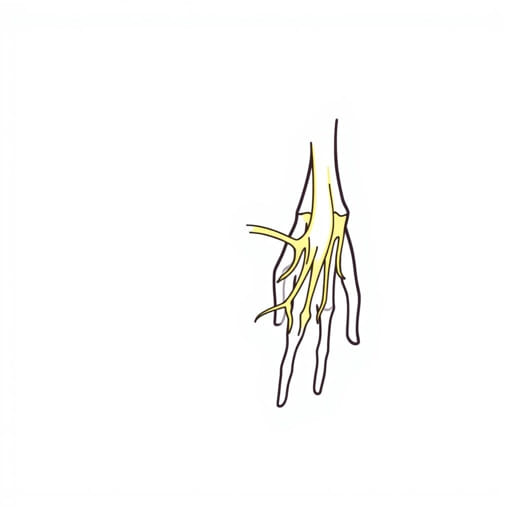
The ulnar nerve plays a crucial role in the function of the hand and forearm. Arising from the brachial plexus, specifically from the C8 and T1 spinal nerve roots, the ulnar nerve is primarily responsible for innervating various muscles that control fine motor movement and grip strength in the hand. Unlike the median and radial nerves, which primarily serve the anterior and posterior compartments of the forearm respectively, the ulnar nerve has a more focused yet essential role, particularly in the intrinsic muscles of the hand. Understanding which muscles are supplied by the ulnar nerve helps explain common clinical signs like ‘claw hand’ and guides diagnosis and treatment of nerve injuries.
Origin and Pathway of the Ulnar Nerve
The ulnar nerve originates from the medial cord of the brachial plexus. It travels down the medial side of the arm, passes behind the medial epicondyle of the humerus (commonly known as the ‘funny bone’), and enters the forearm. From there, it continues into the hand, where it divides into superficial and deep branches, supplying both motor and sensory innervation.
Course Through the Forearm
- In the upper arm: It runs medially without giving off any branches.
- At the elbow: It passes behind the medial epicondyle of the humerus, making it vulnerable to injury.
- In the forearm: It travels between the flexor carpi ulnaris and the flexor digitorum profundus muscles.
- At the wrist: It passes through Guyon’s canal to enter the hand.
Muscles Supplied by the Ulnar Nerve
The ulnar nerve innervates muscles in both the forearm and the hand. However, its influence is most significant in the hand, especially for fine motor control and grip strength. Below is a detailed breakdown of the muscles innervated by the ulnar nerve.
Forearm Muscles
Only two muscles in the forearm receive motor innervation from the ulnar nerve:
- Flexor carpi ulnaris: This muscle lies on the medial side of the forearm and is responsible for flexing and adducting the wrist. It receives direct innervation from the ulnar nerve in the forearm.
- Medial half of flexor digitorum profundus: This deep flexor muscle acts on the distal phalanges of the ring and little fingers. The ulnar nerve innervates the medial half, while the lateral half is supplied by the median nerve.
Hand Muscles
The ulnar nerve provides motor innervation to most of the intrinsic muscles of the hand via its deep branch. These muscles are responsible for precise movements and contribute to the dexterity of the fingers.
Hypothenar Muscles
These muscles form the fleshy mass at the base of the little finger and are exclusively supplied by the ulnar nerve:
- Abductor digiti minimi: Abducts the little finger.
- Flexor digiti minimi brevis: Flexes the proximal phalanx of the little finger.
- Opponens digiti minimi: Allows opposition movement of the little finger toward the thumb.
Palmar Interossei
There are three palmar interossei muscles, and they are responsible for adduction of the fingers toward the midline of the hand. All are innervated by the deep branch of the ulnar nerve.
Dorsal Interossei
These four muscles abduct the fingers away from the midline of the hand. Like the palmar interossei, they are also supplied by the deep branch of the ulnar nerve.
Lumbricals (Medial Two)
The lumbricals are involved in flexing the metacarpophalangeal joints and extending the interphalangeal joints. The ulnar nerve supplies the third and fourth lumbricals (serving the ring and little fingers), while the median nerve supplies the first and second lumbricals (index and middle fingers).
Adductor Pollicis
This muscle adducts the thumb and is crucial for grip strength. It is one of the key thumb muscles not supplied by the median nerve, but rather by the deep branch of the ulnar nerve.
Deep Head of Flexor Pollicis Brevis
Though primarily innervated by the median nerve, the deep head of the flexor pollicis brevis is supplied by the ulnar nerve, contributing to thumb flexion at the metacarpophalangeal joint.
Palmaris Brevis
This small superficial muscle wrinkles the skin on the ulnar side of the palm. It is supplied by the superficial branch of the ulnar nerve, which also provides sensory innervation to the medial one and a half fingers.
Clinical Relevance of Ulnar Nerve Function
Understanding which muscles are supplied by the ulnar nerve helps in diagnosing nerve injuries, especially at the elbow or wrist. Damage to the ulnar nerve can result in a number of characteristic signs and impairments.
Ulnar Nerve Palsy
Injury to the ulnar nerve can lead to muscle weakness or paralysis in the hand. Common signs include:
- Claw hand deformity: Hyperextension at the metacarpophalangeal joints and flexion at the interphalangeal joints, particularly affecting the ring and little fingers.
- Loss of finger abduction/adduction: Due to paralysis of the interossei muscles.
- Reduced grip strength: Especially during pinching or holding objects between the thumb and fingers.
- Wasting of hypothenar eminence: Visible muscle atrophy at the base of the little finger.
Common Sites of Injury
- At the elbow: Cubital tunnel syndrome, where the ulnar nerve gets compressed behind the medial epicondyle.
- At the wrist: Guyon’s canal syndrome, often caused by repetitive compression or trauma to the base of the palm.
Diagnostic Tools
Physicians use various clinical tests to assess the integrity of the ulnar nerve and its supplied muscles, including:
- Froment’s sign: Indicates weakness of adductor pollicis.
- Wartenberg’s sign: Inability to adduct the little finger.
- Electromyography (EMG): Used to assess the electrical activity of the muscles supplied by the ulnar nerve.
Summary of Muscles Supplied by Ulnar Nerve
Forearm
- Flexor carpi ulnaris
- Medial half of flexor digitorum profundus
Hand
- Hypothenar muscles: abductor digiti minimi, flexor digiti minimi brevis, opponens digiti minimi
- Palmar interossei (three muscles)
- Dorsal interossei (four muscles)
- Medial two lumbricals
- Adductor pollicis
- Deep head of flexor pollicis brevis
- Palmaris brevis
The ulnar nerve supplies a diverse group of muscles primarily located in the forearm and hand. Although it serves only two muscles in the forearm, its major impact lies in the hand, where it controls fine motor functions, finger movements, and grip strength. Damage to this nerve can severely affect hand function and quality of life. A strong understanding of the muscles supplied by the ulnar nerve is not only important for anatomy but also for diagnosing and treating nerve injuries effectively. Whether in surgical planning, rehabilitation, or clinical assessments, the role of the ulnar nerve remains essential in upper limb function.