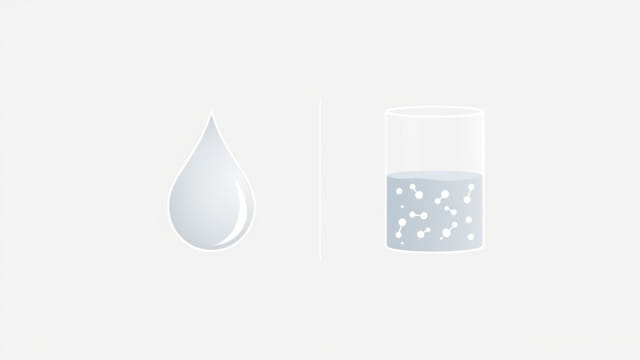
In the world of chemistry and science, understanding the terminology used to describe substances is crucial for clarity and precision. One common point of confusion involves the terms ‘liquid’ and ‘aqueous.’ Although both refer to substances in a fluid state, they are not the same and are used in different contexts. Knowing the difference between a liquid and an aqueous solution is essential in scientific discussions, experiments, and practical applications. This topic explores their definitions, properties, uses, and distinctions in depth to provide a clear understanding of how these terms are applied in real-world situations.
Understanding the Term ‘Liquid’
What Is a Liquid?
A liquid is one of the fundamental states of matter, alongside solid, gas, and plasma. In a liquid state, ptopics are closely packed but not as rigidly as in solids, allowing them to flow and take the shape of their container while maintaining a fixed volume. Liquids can be pure substances or mixtures and are characterized by their ability to flow, incompressibility, and the presence of surface tension.
Examples of Liquids
- Water (H2O)
- Mercury (Hg)
- Alcohols like ethanol
- Oils such as olive oil or motor oil
Each of these substances exists in the liquid state under standard conditions and does not necessarily contain any other material dissolved in them.
What Does ‘Aqueous’ Mean?
Definition of Aqueous Solutions
The term ‘aqueous’ refers to a solution in which the solvent is water. When a substance is dissolved in water, it is said to be in an aqueous state. The abbreviation (aq) is commonly used in chemical equations to denote this condition. Unlike a general liquid, an aqueous solution always contains water as the dissolving medium.
Common Examples of Aqueous Solutions
- Sodium chloride dissolved in water (NaCl(aq))
- Hydrochloric acid in water (HCl(aq))
- Sugar water
- Ammonia in water (NH3(aq))
These examples demonstrate how solutes like salts, acids, or gases become aqueous when mixed with water.
Key Differences Between Liquid and Aqueous
1. Composition
Liquid: A liquid can be a pure substance, such as pure ethanol or mercury, or a mixture. It does not necessarily involve water.
Aqueous: An aqueous solution always involves water as the solvent, with one or more substances dissolved in it.
2. Solvent Requirement
Liquid: No specific solvent is required. A liquid can exist independently without being part of a solution.
Aqueous: Water is a necessary component. Aqueous means the substance is dissolved in water, making water the universal solvent in this context.
3. Representation in Chemistry
Liquid: Represented by the symbol (l) in chemical equations.
Aqueous: Represented by the symbol (aq) to indicate that the substance is dissolved in water.
4. Physical Properties
Liquid: Retains its own chemical identity and properties such as boiling point, density, and viscosity.
Aqueous: Properties depend on both the solvent (water) and the solute. The solution behaves differently than the individual components due to interactions between water molecules and solute ptopics.
5. Appearance
Liquid: May appear clear or colored depending on the substance. For example, pure ethanol is clear and colorless.
Aqueous: Typically appears as a clear solution unless the solute imparts a color, such as copper sulfate, which turns the solution blue.
Why the Distinction Matters in Science
Importance in Chemical Reactions
In chemistry, distinguishing between liquid and aqueous is vital for predicting reaction outcomes. For example, silver nitrate in aqueous solution (AgNO3(aq)) reacts differently than silver nitrate in solid or liquid form. Similarly, hydrochloric acid (HCl) as a gas behaves differently from HCl(aq), which is an acid due to the presence of hydrogen ions in water.
Understanding Solubility
Solubility describes how well a substance dissolves in a solvent. This concept applies directly to aqueous solutions, where substances dissolve in water. Solubility depends on temperature, pressure, and the nature of both the solute and solvent.
Applications in Everyday Life
Aqueous solutions are found in daily life: salt water, sugar in tea, and cleaning solutions. Recognizing them helps in understanding their behavior, storage, and how they interact with other substances.
Misconceptions About Liquids and Aqueous Solutions
All Aqueous Solutions Are Liquids, But Not All Liquids Are Aqueous
This is a common misunderstanding. While aqueous solutions are indeed liquid due to water being the solvent, not all liquids qualify as aqueous. For instance, molten metals like liquid iron are clearly liquids but are not aqueous because they contain no water.
Aqueous Does Not Mean Pure Water
Another misconception is that aqueous simply means water. In reality, it means a substance has been dissolved in water. Pure water itself is a liquid, but not an aqueous solution.
How to Identify If Something is Liquid or Aqueous
Labeling in Chemical Equations
In academic and laboratory settings, substances are labeled clearly to distinguish their states:
- (l) = liquid (e.g., H2O(l))
- (aq) = aqueous (e.g., NaCl(aq))
Observation and Testing
Simple physical observation might not always reveal the difference. However, solubility tests, boiling point measurements, or pH testing can help determine whether a substance is simply a liquid or an aqueous solution containing dissolved ions or compounds.
Understanding the difference between liquid and aqueous is a fundamental concept in chemistry and science education. While both describe substances in fluid states, they are not interchangeable. A liquid is a broad term that refers to any substance in the liquid phase, while an aqueous solution is a specific type of liquid where water acts as the solvent. This distinction is essential not only in academic settings but also in real-life applications such as medicine, engineering, and everyday products. By recognizing and using these terms correctly, one can communicate more accurately and make better decisions in both scientific and practical contexts.