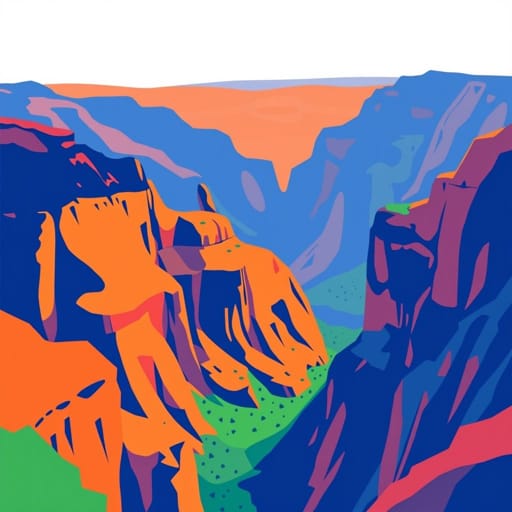
In the world of contemporary art, few names are as recognized and celebrated as David Hockney. Known for his vibrant palette and distinctive approach to perspective, Hockney has explored various subjects across his career, from swimming pools and portraits to vast natural landscapes. One of his most ambitious and visually striking projects is his depiction of the Grand Canyon. His work on this iconic American landscape stands out not only for its scale but also for the innovative way it captures depth, movement, and light. Rather than simply reproducing what the eye sees in a single glance, Hockney’s Grand Canyon paintings invite viewers to experience the scene as something unfolding through space and time.
Background on David Hockney
David Hockney, born in 1937 in Bradford, England, rose to prominence during the 1960s as a leading figure in the British Pop Art movement. His career spans over six decades, and he has worked in a range of media, including painting, photography, printmaking, and digital art. Known for challenging conventional perspectives, Hockney has constantly sought new ways of seeing and representing the world, often drawing inspiration from art history, technology, and his own personal surroundings.
Artistic Philosophy
Central to Hockney’s philosophy is his belief that photography and traditional Western perspective offer only a limited view of reality. He believes that perception is more dynamic and subjective than a single lens can capture. This belief heavily influenced his approach to landscape painting, particularly in works like those inspired by the Grand Canyon.
The Grand Canyon Project
One of Hockney’s most renowned landscape pieces isA Bigger Grand Canyon, a monumental artwork composed of multiple canvases that together create an immersive and panoramic vision of the canyon. Created in 1998, this piece is a vibrant, 60-canvas composition that stretches over 20 feet in width and nearly 8 feet in height. It is now part of the collection at the National Gallery of Australia.
Why the Grand Canyon?
The Grand Canyon has long been a subject of fascination for artists due to its dramatic vistas, ever-changing colors, and sheer scale. For Hockney, the Grand Canyon represented a perfect challenge to traditional visual conventions. The vastness of the landscape could not be adequately captured in a single-point perspective, nor could a photograph do justice to its spatial and atmospheric complexity. Hockney saw in the canyon an opportunity to expand the vocabulary of landscape painting.
Visual Techniques and Composition
InA Bigger Grand Canyon, Hockney used a grid of canvases arranged in a matrix, each one painted separately but meant to be viewed together as a unified whole. This multi-canvas approach allowed him to create a sense of movement through space much like how the eye naturally scans a large environment over time.
Color and Perspective
- Bright oranges, reds, and purples dominate the canyon walls, capturing the play of sunlight and shadow at different times of day.
- He employed shifting perspectives, where the viewer’s vantage point changes slightly from canvas to canvas, mimicking the way we experience real space.
- The use of exaggerated colors and rhythmic forms adds a dreamlike quality that transcends realism.
Instead of presenting the canyon from a single viewpoint, Hockney’s composition includes multiple perspectives, as if one is walking along the rim and observing the changing landscape. This technique mirrors the way we perceive reality not as a frozen moment but as an evolving, lived experience.
Critical Reception
When A Bigger Grand Canyon debuted, it was met with considerable acclaim. Critics praised the work for its ambition, its vibrant aesthetic, and its challenge to the conventions of landscape art. It was also seen as a continuation of Hockney’s long-standing inquiry into how art can represent the complexities of human perception.
Impact on Contemporary Landscape Painting
Hockney’s Grand Canyon paintings have influenced a new generation of artists interested in redefining how landscapes are portrayed. Rather than focusing solely on realism, artists now explore how time, memory, and motion can be included in depictions of space. Hockney’s work serves as a reminder that the landscape genre still holds rich possibilities for innovation and emotional resonance.
Hockney’s Broader Exploration of Nature
The Grand Canyon is not Hockney’s only foray into large-scale natural scenery. In the 2000s, he turned his attention to the countryside of East Yorkshire in England, producing massive paintings that captured the seasonal transformations of the landscape. However, the Grand Canyon series remains one of his most expansive and celebrated efforts in conveying nature’s grandeur.
From Canvas to Digital
In later years, Hockney began using iPads and other digital tools to create art, including landscape works. His exploration of space and color continued through new mediums, yet the spirit of the Grand Canyon paintings experiencing a place in layers and moments persisted. Digital art allowed him to extend his experiments in visual narrative, layering, and perspective.
Symbolism and Interpretation
Beyond the aesthetic experience, many viewers interpret Hockney’s Grand Canyon series as symbolic. The vast, open landscape represents not just physical space, but also the inner terrain of memory, exploration, and artistic freedom. The composition’s fragmentation can be seen as a metaphor for how people piece together meaning from scattered moments and views.
Personal Significance
For Hockney, painting the Grand Canyon was also a personal journey. He visited the site multiple times, and each time he was struck by its immensity and subtle changes in light. His final composition is less a static portrait and more a visual diary each panel capturing a moment, an angle, or a feeling that contributed to the whole experience.
David Hockney’s Grand Canyon work is a landmark achievement in modern landscape art. It challenges traditional notions of perspective and offers a fresh, dynamic way of seeing the natural world. By combining vibrant colors, innovative techniques, and a deep understanding of visual perception, Hockney turned a familiar subject into something profoundly new. His Grand Canyon paintings are not just representations they are experiences, inviting viewers to step inside the landscape and rediscover the power of seeing. As both an artistic and philosophical statement, the project continues to resonate with audiences and artists alike, reinforcing Hockney’s place as one of the most visionary painters of our time.