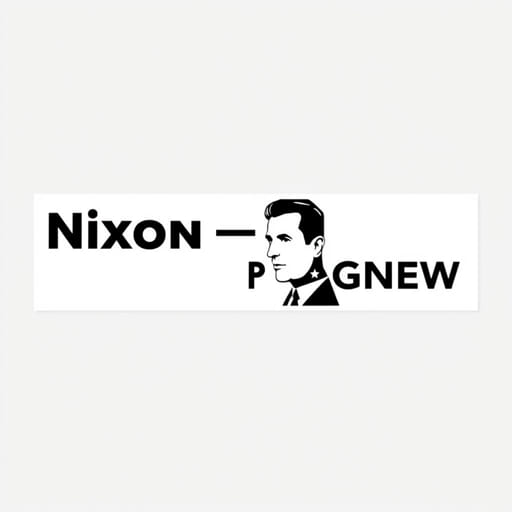
The Nixon-Agnew bumper sticker is more than just a political campaign item; it’s a cultural artifact that reflects a complex and pivotal era in American history. These small rectangular decals, often displayed on the bumpers of cars during the 1968 and 1972 presidential elections, represented the strong support base for Richard Nixon and his vice presidential running mate, Spiro Agnew. While seemingly simple, the Nixon Agnew bumper sticker encapsulates the spirit of conservative America, the battle against liberal ideology, and the struggle for national unity in a time of great division. As political memorabilia, these stickers have gained new relevance for collectors, historians, and those interested in the political branding of the past.
Origins of the Nixon Agnew Campaign
Richard Nixon, having lost the 1960 presidential election and the 1962 California gubernatorial race, made a surprising political comeback in 1968. He selected Spiro Agnew, then Governor of Maryland, as his running mate a choice that stirred both support and criticism. The duo represented a ‘law and order’ ticket that appealed to the so-called ‘silent majority’ of Americans who were disillusioned by the social upheaval, civil rights protests, and anti-war demonstrations that characterized the 1960s.
The campaign heavily relied on slogans and visuals that could easily be disseminated among the masses. Among these, the Nixon Agnew bumper sticker became a symbol of conservative pride. It was a quick way for supporters to identify themselves in a polarized political environment.
Design and Message
The typical Nixon Agnew bumper sticker featured bold typography, patriotic colors, and straightforward messaging. Most versions bore simply the names Nixon and Agnew, often accompanied by the year of the election, like Nixon-Agnew ’68 or Nixon-Agnew ’72. Red, white, and blue were the dominant color scheme, tapping into American nationalism and a sense of civic duty.
These bumper stickers were designed to be clear, recognizable, and direct. They could be read at a glance while driving, and their placement on cars allowed for widespread, mobile advertising. Unlike television or newspaper ads, bumper stickers operated on a grassroots level, turning every vehicle into a rolling campaign sign.
The Role of Political Memorabilia
Political memorabilia has long been a part of American electoral culture. Buttons, hats, posters, and bumper stickers all serve as tools for visibility and allegiance. The Nixon Agnew bumper sticker, in particular, played a key role in solidifying voter loyalty.
- Visibility: As cars traveled across towns and states, these stickers reached audiences beyond local rallies or television broadcasts.
- Identity: Displaying a bumper sticker allowed individuals to publicly align themselves with Nixon’s conservative message.
- Collectibility: Today, original Nixon Agnew stickers are valued among collectors for their historical and nostalgic value.
Beyond their functional use during the campaigns, these stickers now act as windows into a past political climate, offering insight into how Americans communicated their political views before the age of social media.
The 1968 Campaign and Its Context
The 1968 election was one of the most tumultuous in American history. The country was reeling from the assassination of Martin Luther King Jr., followed by the killing of Senator Robert F. Kennedy. Anti-war protests were escalating, and the Democratic National Convention in Chicago erupted in violence. In this volatile atmosphere, Nixon positioned himself as the candidate who would restore order and peace.
The bumper sticker featuring Nixon and Agnew represented more than a vote; it symbolized a desire for stability. It appealed to citizens weary of the chaos, advocating a return to traditional American values. While critics labeled this as resistance to social progress, supporters saw it as necessary leadership.
The 1972 Re-Election and a Changing Narrative
In 1972, the Nixon Agnew ticket returned with even stronger messaging. Nixon’s campaign was riding high on foreign policy successes such as his visit to China and détente with the Soviet Union. Agnew, meanwhile, gained notoriety for his fiery speeches criticizing the media and liberal elites.
Newer versions of the Nixon Agnew bumper sticker appeared, often with more stylized designs and slogans like Now More Than Ever Nixon Agnew. These emphasized continuity and experience, capitalizing on the fear of change in uncertain times.
However, both figures would later face significant scandals. Agnew resigned in 1973 amid tax evasion charges, and Nixon would step down in 1974 following the Watergate scandal. Yet, the image of their unity as portrayed on bumper stickers remains a lasting visual from a time when politics took to the highways.
Legacy and Collectibility
Today, Nixon Agnew bumper stickers are sought after by collectors of political memorabilia. They are found in museums, online auctions, and personal collections. They hold value not only for their rarity but also for the stories they carry stories of a divided nation, a complex presidency, and the ever-changing tactics of political marketing.
For many historians, these stickers symbolize a transitional period in American politics. They represent the rise of the modern political campaign, the influence of media on elections, and the power of branding in shaping public perception.
A Symbol of a Political Era
Though small and seemingly insignificant, the Nixon Agnew bumper sticker played a powerful role in two presidential campaigns that reshaped the American political landscape. More than a campaign tool, it served as a cultural signal, a badge of belief, and now, a relic of a deeply influential time. Whether displayed on a dusty car or preserved behind museum glass, it speaks volumes about the way Americans express their political identities and the enduring nature of visual symbols in shaping public opinion.
For those studying political history, campaign marketing, or the Nixon presidency, the Nixon Agnew bumper sticker remains a fascinating artifact one that bridges the gap between personal expression and national discourse.