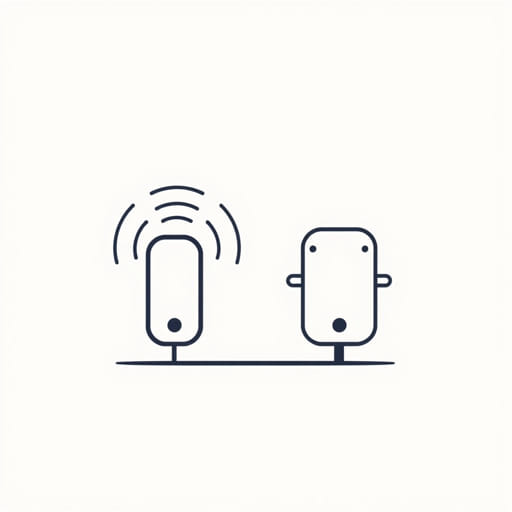
Zigbee transmitter and receiver modules play a vital role in wireless communication systems, especially for low-power and short-range applications. They are widely used in home automation, industrial monitoring, medical devices, and smart agriculture. Designed to work on IEEE 802.15.4 protocol, Zigbee technology allows various devices to communicate in a secure, reliable, and energy-efficient way. These modules are ideal for transmitting data over a wireless mesh network where multiple nodes can send and receive signals. The interaction between a Zigbee transmitter and receiver enables real-time communication between microcontrollers, sensors, and other smart devices.
What is Zigbee?
Zigbee is a wireless communication protocol developed for low-power digital radio signals. It is mainly used for communication between devices in a personal area network (PAN) with limited data requirements. Zigbee is designed to provide low-latency communication with low energy consumption, making it suitable for devices that rely on battery power for long periods.
Key Features of Zigbee Technology
- Operates on the 2.4 GHz frequency band globally
- Supports star, tree, and mesh network topologies
- Low data transfer rate (up to 250 kbps)
- Secure communication with 128-bit AES encryption
- Energy-efficient and cost-effective
Zigbee Transmitter
A Zigbee transmitter is a component or module that sends data wirelessly to a Zigbee receiver or another node in the network. It converts electrical signals into radio waves and emits them into the air. These transmitters are typically embedded in microcontroller-based systems and paired with sensors or user inputs to send specific data across a network.
Main Functions
- Encodes and transmits digital data as radio frequency signals
- Operates using low power for extended battery life
- Initiates communication with receivers or network coordinators
Common Zigbee Transmitter Modules
- XBee Series 2 (Zigbee-based)
- Digi Zigbee SMT Modules
- CC2530 Zigbee Module
These modules can be integrated with development boards such as Arduino or Raspberry Pi for rapid prototyping and deployment in IoT projects.
Zigbee Receiver
A Zigbee receiver is responsible for capturing and decoding radio frequency signals sent by a Zigbee transmitter. It converts the incoming RF signals back into electrical signals and passes them to a microcontroller or processor. The receiver listens for transmissions either continuously or at regular intervals, depending on the application and power-saving settings.
Main Functions
- Receives wireless data from a Zigbee transmitter
- Processes the incoming signal and interprets the data
- Communicates with a microcontroller or external system for action
Key Attributes
- High sensitivity to detect low-power transmissions
- Low standby power consumption
- Configurable to receive data only from specific nodes
How Zigbee Transmitter and Receiver Work Together
The communication between a Zigbee transmitter and receiver is established through a wireless mesh or star network. Each Zigbee device can act as a transmitter, receiver, or repeater (router). The transmitter sends a packet of data, which is then received by the receiver. Acknowledge signals ensure that data is successfully received.
Steps in the Communication Process
- The transmitter converts sensor data into a wireless signal.
- This signal is modulated and sent over a predefined Zigbee channel.
- The receiver captures the RF signal and demodulates it.
- The received data is then delivered to the connected processor.
Because Zigbee supports mesh networking, even if a direct connection between transmitter and receiver is not possible, data can be routed through intermediary devices to reach its destination.
Applications of Zigbee Transmitter and Receiver
Zigbee technology, due to its low energy consumption and reliable communication, is used in a wide range of wireless applications. Transmitter and receiver pairs form the backbone of these applications by enabling two-way communication between devices.
Examples of Real-World Applications
- Home Automation: Used in smart light control, security sensors, and HVAC systems.
- Industrial Automation: Enables monitoring of machinery and environmental conditions.
- Smart Agriculture: Collects data from soil moisture sensors and weather monitors.
- Medical Monitoring: Transfers health data from wearable devices to central systems.
- Smart Energy: Used in wireless metering and energy usage tracking systems.
Advantages of Using Zigbee Transmitter and Receiver
The combination of Zigbee transmitter and receiver modules provides many benefits for modern wireless systems. Their compact design and low energy requirements make them especially useful for embedded applications where long battery life and stable communication are priorities.
- Energy Efficiency: Operates on minimal power, suitable for battery-powered devices
- Network Flexibility: Supports multiple devices in a mesh layout
- Low Cost: Affordable modules for large-scale deployment
- Scalability: Easily expandable networks with additional nodes
- Security: Built-in encryption and authentication protocols
Challenges and Limitations
Although Zigbee offers many advantages, there are some limitations associated with its transmitter and receiver modules:
- Limited Range: Generally up to 100 meters in open space; less indoors due to walls and interference
- Lower Data Rate: Not suitable for applications requiring high-speed data transfer
- Interference: Can be affected by other 2.4 GHz devices like Wi-Fi and Bluetooth
Despite these limitations, for many IoT applications that prioritize power efficiency and simple data transmission, Zigbee remains an ideal solution.
Zigbee transmitter and receiver modules are essential components in the world of low-power wireless communication. They provide a simple and effective way to send and receive data in a variety of applications, from smart homes to industrial systems. With their compact size, energy efficiency, and mesh networking capabilities, Zigbee systems offer reliable and secure solutions for modern IoT challenges. Understanding how these transmitters and receivers function can help developers and engineers create more responsive, efficient, and interconnected systems.