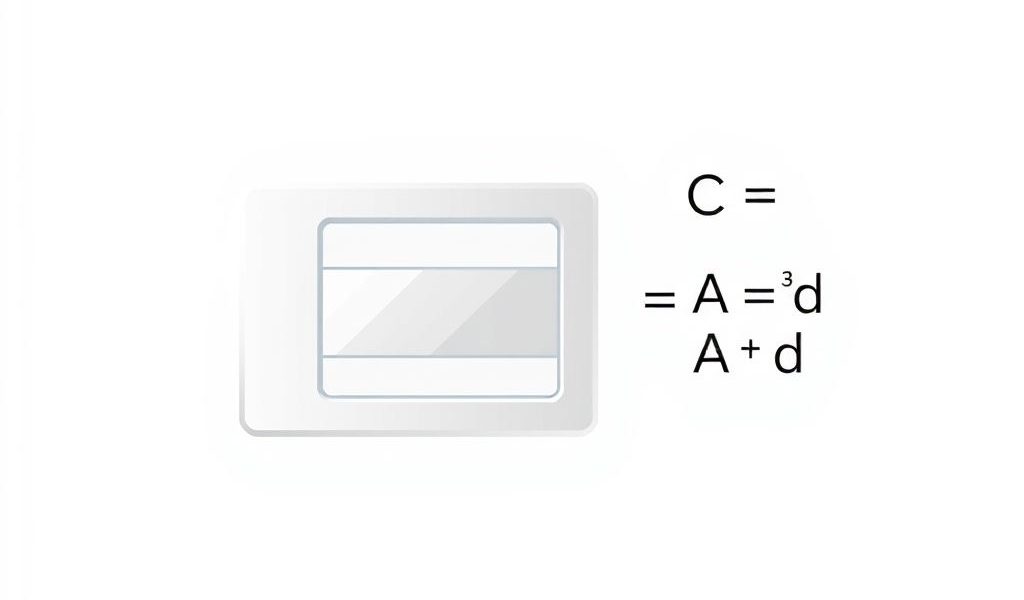
The concept of a parallel plate capacitor is one of the most essential topics in the field of electrostatics and electronics. It serves as a fundamental building block for understanding how electrical energy can be stored and managed in various circuits and devices. When a dielectric material is inserted between the plates of the capacitor, the behavior of the system changes significantly, altering its ability to store charge. Understanding the parallel plate capacitor formula with dielectric is crucial for physics students, electrical engineers, and anyone working with electronic systems. This topic aims to explain the concept thoroughly, breaking it down into easily understandable components while also covering its mathematical basis and practical applications.
What Is a Parallel Plate Capacitor?
A parallel plate capacitor is a device that stores electrical energy by accumulating opposite charges on two conductive plates separated by an insulating material. When connected to a voltage source, the plates accumulate positive and negative charges respectively, creating an electric field between them.
Basic Structure
- Two flat, parallel conductive plates
- Uniform separation between the plates
- An insulating medium (air or vacuum by default)
The simplest configuration assumes the gap between the plates is filled with air or vacuum, which has a dielectric constant approximately equal to 1. However, when a dielectric material is introduced, the behavior of the capacitor changes due to the dielectric’s ability to reduce the effective electric field.
Capacitance Without a Dielectric
The basic formula for the capacitance of a parallel plate capacitor without a dielectric is given by:
C = εâ à A / d
Where:
- Cis the capacitance in farads (F)
- εâis the vacuum permittivity (approximately 8.85 à 10â»Â¹Â² F/m)
- Ais the area of one of the plates in square meters (m²)
- dis the distance between the plates in meters (m)
This formula shows that the capacitance is directly proportional to the area of the plates and inversely proportional to the separation between them. Larger plates and closer spacing result in higher capacitance.
Capacitance With a Dielectric
When a dielectric material is inserted between the plates, the formula is modified to include the dielectric constant (κ):
C = κ à εâ à A / d
Here, κ (kappa) represents the relative permittivity of the dielectric material. It is a dimensionless quantity greater than 1. The presence of a dielectric increases the capacitance of the capacitor because it reduces the electric field, allowing more charge to be stored for the same voltage.
Understanding the Role of Dielectric
Dielectrics are insulating materials like glass, ceramic, plastic, or mica. They work by polarizing in the presence of an electric field, which reduces the effective field inside the capacitor. As a result:
- More charge can be stored on the plates
- The same voltage leads to greater capacitance
- Energy storage capacity increases
The dielectric constant varies depending on the material. For example:
- Air: ~1.0
- Paper: ~3.7
- Glass: ~4 to 10
- Water: ~80 (very high)
Derivation of the Formula
Starting with Gauss’s Law
To understand the formula from a theoretical standpoint, one can start with Gauss’s Law, which relates the electric field (E) between the plates to the surface charge density (Ï):
E = Ï / ε
Where ε = εâ à κ. The potential difference (V) between the plates is then:
V = E à d = (Ï Ã d) / (εâ à κ)
Now, since capacitance is defined as:
C = Q / V
And surface charge density Ï = Q / A, we substitute back:
C = (Q à κ à εâ) / (Q à d / A) = κ à εâ à A / d
This confirms the earlier formula using fundamental principles of electrostatics.
Practical Implications
Designing Capacitors
In practical electronics, dielectric materials are chosen carefully based on the intended application. Factors such as dielectric breakdown strength, stability with temperature, and permittivity influence the material selection. Designers use the formula for parallel plate capacitors with dielectric to determine dimensions and materials needed for achieving specific capacitance values.
Energy Storage
Energy stored in a capacitor is given by:
U = (1/2) à C à V²
Because adding a dielectric increases C, it also increases the stored energy for a given voltage. This makes dielectrics essential in high-capacity energy storage systems like defibrillators, power conditioners, and even in renewable energy systems.
Capacitors in AC Circuits
Capacitors are widely used in alternating current (AC) circuits for applications such as filtering, tuning, and timing. The increased capacitance due to a dielectric enhances the capacitor’s ability to affect signal behavior, making dielectric choice crucial in radio, television, and audio systems.
Limitations and Considerations
Dielectric Breakdown
Every dielectric has a breakdown voltage, above which it loses its insulating properties and becomes conductive. This can destroy the capacitor or even cause circuit damage. Thus, one must ensure that the applied voltage remains below the breakdown limit of the dielectric material.
Temperature Dependence
Dielectric properties can vary with temperature. In precision circuits, this can lead to fluctuations in capacitance, affecting performance. Some dielectric materials are specifically engineered to have minimal temperature dependence.
Leakage Current
While dielectrics are insulating, real materials are not perfect. A small amount of current may leak through, particularly over time or under high voltage. This leakage can be problematic in circuits that require long-term charge storage.
The formula for a parallel plate capacitor with a dielectric is central to understanding and designing capacitors in modern electronics. By inserting a dielectric between the plates, the capacitance increases by a factor equal to the material’s dielectric constant. This allows for more compact designs and improved performance across a wide range of applications. Whether you are a student learning the basics of electromagnetism or an engineer designing cutting-edge electronic devices, mastering this formula is essential. The principles that govern capacitors with dielectrics not only appear in textbooks and exams but also power real-world innovations from smartphones to medical devices to power grids.