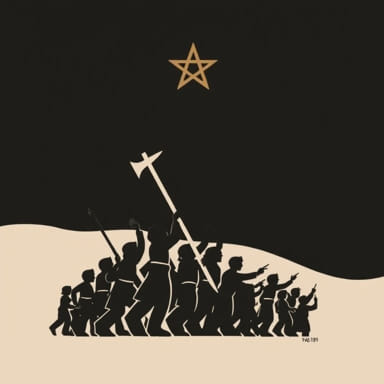
The Bolshevik Revolution, also known as the October Revolution of 1917, was a defining moment in Russian and global history. Its purpose was not simply the overthrow of the Provisional Government, but a radical transformation of Russian society. Driven by the ideas of Karl Marx and led by figures such as Vladimir Lenin and Leon Trotsky, the revolution aimed to replace the old structures of monarchy and capitalism with a proletarian-led socialist system. This revolution was rooted in widespread dissatisfaction with social inequality, war, and political repression, and it had long-lasting consequences that echoed throughout the 20th century. Understanding the core goals of the Bolsheviks reveals their vision of a new political, economic, and social order.
Historical Background of the Bolshevik Movement
Decline of the Tsarist Regime
For centuries, Russia was ruled by autocratic tsars who exercised unchecked power over their subjects. The gap between the wealthy elite and the suffering peasantry grew increasingly wider. Efforts to reform the system in the late 19th and early 20th centuries failed to address the deep-rooted problems of poverty, landlessness, and lack of political representation.
The Russian Revolution of 1905 was an early sign of growing unrest. Although it resulted in the creation of the Duma (parliament), Tsar Nicholas II retained most of his authority. By the time World War I began in 1914, the Russian Empire was already teetering on the edge of collapse.
The Impact of World War I
Russia’s participation in World War I had devastating effects on the economy and morale. Soldiers lacked basic supplies, food shortages plagued the cities, and inflation soared. The military defeats and the Tsar’s inability to manage the crisis led to the February Revolution of 1917, which forced Nicholas II to abdicate. The Provisional Government that replaced the monarchy promised democratic reforms but failed to withdraw from the war or address land and labor issues, further frustrating the masses.
Ideological Foundations of the Bolsheviks
Marxist Principles
The Bolsheviks were influenced by the writings of Karl Marx, who argued that history was driven by class struggle. Marx envisioned a future in which the working class, or proletariat, would rise against the bourgeoisie (capitalist class) and create a classless, stateless society. Lenin adapted these ideas to the Russian context, arguing that a vanguard party of professional revolutionaries was necessary to lead the workers to power.
Lenin’s Vision
Vladimir Lenin believed that Russia could skip the capitalist phase of development and move directly to socialism. He saw the state as a tool for suppressing the bourgeoisie and building a new socialist order. His pamphlet ‘What Is to Be Done?’ outlined his belief in a tightly organized party capable of directing the revolution. The Bolsheviks, under his leadership, sought to end the war, transfer power to the Soviets (workers’ councils), and redistribute land to the peasants.
Key Purposes of the Bolshevik Revolution
1. Overthrow of the Provisional Government
The immediate aim of the Bolsheviks in October 1917 was to topple the Provisional Government, which they saw as incapable of solving Russia’s problems. By seizing key institutions in Petrograd and declaring power in the hands of the Soviets, the Bolsheviks effectively removed the existing authority and established a new regime based on socialist principles.
2. Withdrawal from World War I
One of the most urgent promises made by the Bolsheviks was to end Russia’s involvement in World War I. The Treaty of Brest-Litovsk, signed in March 1918, achieved this by conceding large amounts of territory to Germany. While the treaty was controversial, it fulfilled the popular demand for peace and allowed the Bolsheviks to focus on domestic issues.
3. Redistribution of Land
Land reform was a crucial goal of the revolution. The Bolsheviks abolished the landed aristocracy and redistributed land to peasants, addressing centuries of inequality. This helped gain support from rural areas, though the policy later shifted during collectivization under Stalin. Still, the initial redistribution was a key purpose of the revolution.
4. Establishment of a Dictatorship of the Proletariat
Rather than liberal democracy, the Bolsheviks advocated for a dictatorship of the proletariat a transitional state in which the working class would hold power through the Soviets. This involved eliminating class enemies, dismantling capitalist institutions, and controlling industry and banking through nationalization.
5. Suppression of Counter-Revolutionary Forces
To maintain control and protect the revolution, the Bolsheviks formed the Cheka (secret police) to eliminate opposition. They also fought a bloody civil war against the White Army, which was supported by foreign powers. The goal was not just to win militarily, but to secure ideological dominance by crushing any return to capitalism or monarchy.
6. Spreading the Global Socialist Revolution
Another important aim was to ignite similar uprisings in other countries. The Bolsheviks believed that socialism in one country could not survive without international support. Although revolutions failed in places like Germany and Hungary, the formation of the Communist International (Comintern) in 1919 reflected the global ambitions of the Bolshevik leadership.
Long-Term Goals and Vision
Creation of a Classless Society
The ultimate purpose of the Bolshevik Revolution was the creation of a society free of class divisions, where the means of production were collectively owned. Education, healthcare, and labor rights were emphasized as essential components of this vision. While achieving such a society proved challenging, these goals remained central to the ideology.
Centralized Economic Planning
To replace the capitalist economy, the Bolsheviks introduced centralized planning. The state controlled production, distribution, and pricing in an attempt to eliminate exploitation and profit-driven motives. Though this led to some economic growth, it also caused shortages, inefficiency, and widespread hardship during certain periods.
Challenges and Contradictions
Authoritarian Measures
In pursuit of their goals, the Bolsheviks often resorted to authoritarian methods. Political opposition was banned, and dissent within the Communist Party was stifled. This contradicted the democratic ideals they claimed to support, leading to a centralized and often repressive regime.
Economic Struggles
The shift to a command economy was not smooth. War communism caused widespread famine and unrest, forcing Lenin to introduce the New Economic Policy (NEP) in 1921 a partial return to market mechanisms. This demonstrated the gap between ideological purity and practical governance.
Legacy of the Bolshevik Revolution
The Bolshevik Revolution reshaped Russia and had profound global consequences. It marked the first successful attempt to build a socialist state and inspired revolutionary movements around the world. While its outcomes were mixed ranging from industrial modernization to political repression the revolution’s original purposes reveal a desire to build a more just and equal society by overthrowing oppressive systems. The transformation of Russia from an imperial monarchy to a communist superpower began with the radical ambitions of the Bolsheviks, whose revolution changed the course of the 20th century.