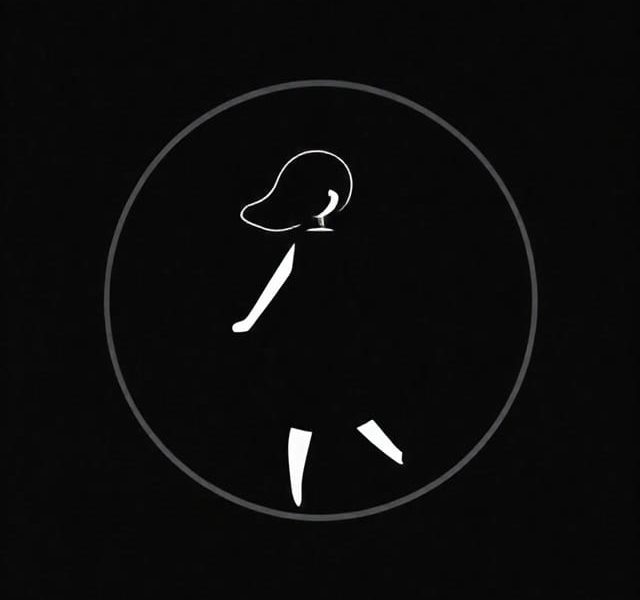
One of the most talked-about optical illusions in recent years is the girl spinning clockwise or anticlockwise animation. This spinning silhouette of a dancer sparked global interest due to its strange ability to appear as spinning in two different directions depending on how one perceives it. Some people swear she is spinning clockwise, while others are convinced she is going anticlockwise. More interestingly, some viewers can switch between the two perceptions. This illusion has been widely discussed as a fun personality test or even as a way to determine if someone is more ‘right-brained’ or ‘left-brained,’ but the reality behind it is grounded in psychology, perception, and how the human brain interprets ambiguous visual cues.
The Spinning Girl Optical Illusion
The spinning girl, also known as the spinning dancer illusion, is a simple silhouette animation of a female figure spinning around. Created in 2003 by Nobuyuki Kayahara, this animation is a two-dimensional image, yet it appears to rotate in a three-dimensional space. The illusion happens because the figure lacks depth cues meaning there’s no clear indication of which leg is in front or which direction the dancer is facing. As a result, our brains fill in the missing information, leading to varied interpretations.
Clockwise or Anticlockwise?
Whether you see the girl spinning clockwise or anticlockwise often depends on how your brain interprets the shadowy, depthless image. With no definitive front or back to the figure, your mind can choose either direction. This is what makes the illusion so fascinating and perplexing.
- If you see her spinning clockwise, you may initially perceive her right leg as the one extended.
- If you see her spinning anticlockwise, your mind interprets her left leg as the one moving outward.
These interpretations flip based on how your brain fills in the gaps of spatial understanding. Since the image provides no visual confirmation of depth or position, your perception becomes the deciding factor.
Perception and Brain Function
Is It About Left Brain vs. Right Brain?
One of the most common claims about the spinning girl illusion is that people who see the girl spinning clockwise are using their right brain, associated with creativity and emotions, while those who see it spinning anticlockwise are using their left brain, associated with logic and analysis. However, this theory is largely a myth. While the left and right hemispheres of the brain do specialize in different functions, perception is far more complex and cannot be so neatly divided.
Scientific research does not support the idea that this illusion reveals anything definitive about which side of your brain you use more. In truth, most cognitive functions involve activity from both hemispheres of the brain. The illusion is more a testament to how visual perception and brain processing can vary from person to person, even in a shared environment.
Why Does the Brain Flip the Direction?
The flipping effect where you can suddenly see the girl spinning the other way is related to something called bistable perception. This occurs when the brain is presented with ambiguous or conflicting visual information and can interpret it in more than one way. Just like the famous Necker cube, which can flip orientation as you look at it, the spinning girl can switch direction when your brain chooses an alternative interpretation of the visual cues.
Focusing on a particular part of the animation like the foot, arm, or shadow can trigger the switch. It’s also influenced by attention, fatigue, or even your peripheral vision. In fact, some people can train themselves to see the spin change back and forth at will.
How to Make the Girl Spin the Other Way
Tips to Switch Perception
If you’re stuck seeing the girl spin only one way and want to test your perception skills, there are a few techniques you can try:
- Look at the feet: Focus on the shadow or the base of the foot where it touches the ground. This can help your brain re-interpret the rotation.
- Blink rapidly: Blinking or closing your eyes briefly may reset your brain’s interpretation of the movement.
- Use peripheral vision: Try looking slightly to the side of the image and notice if the direction changes in your peripheral vision.
- Cover part of the image: Blocking out the upper body and focusing only on the legs, or vice versa, can help flip the direction.
With a bit of patience, many viewers find they can eventually control the perceived direction of the spin. This is a great example of how flexible and adaptable human perception can be.
The Psychology Behind the Illusion
Visual illusions like this are not just fun they also reveal important insights into how our brains work. Our visual system is constantly trying to make sense of the world, using prior knowledge, experience, and contextual clues to form a coherent picture. When presented with incomplete or ambiguous data, as in the case of the spinning girl, the brain must ‘guess’ what it’s seeing. Sometimes, different people guess differently. That’s why two people looking at the same animation can be equally sure they’re seeing opposite directions of rotation.
This ability of the brain to shift between interpretations shows that perception is not a fixed process. Instead, it is active, fluid, and deeply influenced by individual cognition. In fields such as psychology and neuroscience, illusions like these are often used to explore the limits and capabilities of visual processing.
Social Media and Viral Popularity
The spinning girl illusion gained massive popularity online, especially on platforms like Twitter, Facebook, and Reddit. Users loved debating which direction the girl was spinning and what it said about them. It became a viral test of perception, often used in personality quizzes or cognitive challenges.
Despite the misconceptions about brain dominance, the discussion it sparked helped millions learn a bit more about visual perception, ambiguity, and how the human brain constructs reality from limited information. It also encouraged people to become more curious about how their minds work a positive outcome of a simple illusion.
The girl spinning clockwise or anticlockwise is more than just an internet curiosity. It’s a powerful demonstration of how our brains interpret the world around us, even when the data is incomplete or contradictory. This optical illusion encourages us to reflect on the nature of perception, reality, and the brain’s incredible capacity to adapt and adjust to changing stimuli.
Whether you see her turning clockwise or anticlockwise, there’s no right or wrong answer. It’s all about how your brain chooses to fill in the blanks. That’s what makes this illusion both scientifically valuable and endlessly entertaining.