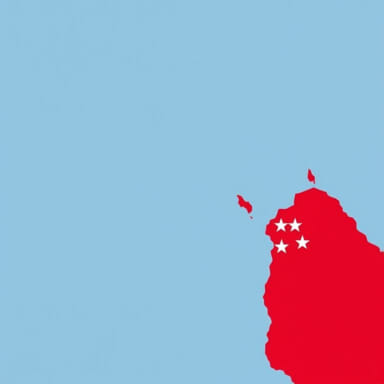
The Queensland annexation of New Guinea in the late 19th century was a significant yet controversial episode in the colonial expansion of the British Empire in the Pacific. It involved the unilateral action by the colony of Queensland, then part of British-ruled Australia, to claim territory on the southeastern portion of New Guinea, despite lacking direct authorization from the British government in London. This act reflected broader concerns about foreign powers encroaching on nearby lands, especially Germany, and illustrated the complexities of colonial governance and imperial ambition in the region. Understanding this moment in history sheds light on the colonial relationship between Australia and the Pacific islands, and how political fears, commercial interests, and nationalism shaped territorial expansion.
Background to the Annexation
New Guinea, the world’s second-largest island, lies just to the north of Australia. In the late 1800s, European interest in the Pacific was growing rapidly due to trade, missionary activity, and geopolitical competition. While the Dutch had long held control over western New Guinea (modern-day Indonesian Papua), the eastern part of the island remained largely unclaimed by European powers until the 1880s.
Strategic and Economic Concerns
Queensland, one of the Australian colonies, was particularly concerned about potential foreign occupation of eastern New Guinea. The colony had strong economic ties to the Pacific and feared that if a rival European power such as Germany established a presence there, it could threaten trade routes, labor supply, and regional security. Sugar planters in Queensland were also reliant on labor from the Pacific Islands, including New Guinea, further fueling interest in the region.
Additionally, settlers and politicians in Queensland believed that New Guinea could be a source of natural wealth, including timber, minerals, and fertile land. These factors combined to create pressure for preemptive action.
The 1883 Unilateral Action by Queensland
In April 1883, without waiting for approval from Britain, the Queensland colonial government sent a party to formally annex the southeastern portion of New Guinea. This region would later be known as British New Guinea. The claim was made by Government Agent Henry Chester on behalf of the Queensland Premier, Sir Thomas McIlwraith. The act involved raising the Union Jack and declaring the territory under British protection.
Reaction in Britain
The Queensland annexation of New Guinea created political embarrassment for the British government. While London understood the strategic concerns of its Australian colony, it had not authorized the annexation and initially refused to recognize it. At the time, Britain was pursuing a policy of caution in the Pacific and was reluctant to take on new colonial responsibilities that might antagonize other powers or burden the empire financially.
However, news of possible German interest in northern New Guinea added urgency to the situation. Public pressure in both Britain and the Australian colonies mounted, and eventually, the British government reversed its initial decision. In 1884, the southeastern portion of New Guinea was officially declared a British protectorate under the name of British New Guinea, effectively formalizing Queensland’s earlier claim.
German Annexation of Northeastern New Guinea
Meanwhile, Germany moved quickly to assert control over the northeastern portion of the island. In November 1884, just months after Britain declared its protectorate, the German flag was raised in the Bismarck Archipelago and northeastern New Guinea, establishing what became known as German New Guinea. This division of the island into British and German spheres of influence marked the beginning of formal colonial administration on the island and intensified the imperial rivalry in the Pacific.
Division of the Island
- Western New Guinea Controlled by the Dutch, part of the Dutch East Indies.
- Eastern New Guinea Divided between British New Guinea (southeast) and German New Guinea (northeast).
This partition laid the groundwork for the political geography of the region well into the 20th century, with long-lasting effects on the people and societies of New Guinea.
Impact on the Indigenous Population
The Queensland annexation of New Guinea and subsequent colonial rule had a significant impact on the indigenous peoples of the island. These societies, which were diverse and organized along complex cultural lines, were suddenly brought under foreign governance. Colonial authorities imposed new systems of law, trade, land ownership, and labor, often disregarding traditional customs and practices.
Changes in Land Use and Labor
One of the most disruptive consequences of colonization was the expropriation of land. European settlers and colonial administrators began mapping, claiming, and exploiting land for plantations and commercial use. Indigenous communities were sometimes displaced or forced into labor systems. The introduction of cash economies and foreign legal structures altered the social fabric of New Guinea societies.
Missionary Activity
Alongside colonial governance, Christian missionaries many of them from Australia and Europe arrived in large numbers. They aimed to convert indigenous populations, provide education, and civilize local communities. While some indigenous people adopted aspects of Christianity and Western culture, others resisted. The cultural transformation during this period was both profound and contested.
Administrative Transition and Federation
Although the initial annexation was undertaken by Queensland, the administration of British New Guinea was later transferred to the British government, and then in 1906 to the newly formed Commonwealth of Australia. This marked a shift from colonial action by an individual Australian colony to coordinated national control under the federal system.
Australia’s Role in Papua
The region became known as the Territory of Papua, and Australia took on responsibility for its governance. Australian administrators, laws, and settlers increasingly shaped the development of the territory. During World War I, Australia also occupied German New Guinea, which was later placed under Australian mandate by the League of Nations after the war.
This expansion of Australia’s role in New Guinea traced its origins directly to the 1883 Queensland annexation, showing how early colonial actions had long-term implications for the region’s political history.
Legacy of the Annexation
The Queensland annexation of New Guinea holds a complex place in both Australian and Pacific history. It reflects the assertive attitudes of colonial Australia, the tension between local colonial governments and imperial authorities, and the broader dynamics of European competition in the Pacific. Although the annexation was initially unauthorized, it ultimately led to lasting colonial involvement by Australia in Papua New Guinea.
Historical Significance
- Demonstrated the growing autonomy of Australian colonies in foreign affairs.
- Reflected colonial anxieties about foreign powers in the Pacific.
- Laid the groundwork for Australia’s long-standing involvement in Papua New Guinea.
- Highlighted the neglect of indigenous rights in the process of territorial expansion.
The Queensland annexation of New Guinea in 1883 was a bold and controversial act that had far-reaching consequences. While it was initially rejected by Britain, it prompted the formal establishment of British New Guinea and a subsequent chain of events that would shape the political development of the entire island. The annexation illustrates the ambitions and fears of colonial Australia, the complexities of imperial diplomacy, and the long shadow of colonialism on the indigenous peoples of New Guinea. As a moment of both local initiative and imperial entanglement, it remains a key episode in the history of Australian-Pacific relations.
#kebawah#