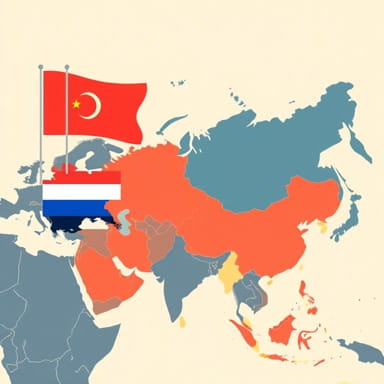
In the aftermath of World War II, the global balance of power shifted dramatically. The destruction left behind by years of war left many nations economically weakened and politically unstable. However, out of the rubble emerged a few powerful countries that would go on to shape the international order for decades to come. These strong nations that dominated the postwar world established global institutions, exerted influence over smaller countries, and engaged in economic and military strategies that solidified their status as world powers. The competition between these nations defined the Cold War era, reshaped geopolitics, and laid the foundation for modern international relations.
The Rise of the United States as a Global Superpower
The United States emerged from World War II in a uniquely powerful position. Unlike European countries whose infrastructure was devastated by the war, the U.S. mainland remained untouched, and its economy had boomed during wartime production. America possessed the world’s largest industrial base, the strongest navy, and, by 1945, a nuclear monopoly.
Economic and Military Influence
The U.S. used its economic strength to rebuild war-torn Europe through the Marshall Plan, providing over $12 billion (approximately $130 billion in today’s dollars) in aid. This not only helped stabilize Europe but also promoted the spread of capitalism and democracy. Militarily, the United States established permanent military bases across Europe, Asia, and the Pacific, solidifying its role in global security.
Creation of International Institutions
American leadership was instrumental in creating the United Nations, the International Monetary Fund (IMF), and the World Bank. These institutions served to reinforce the U.S.’s vision of a liberal world order based on open markets, political self-determination, and cooperative security.
The Soviet Union and the Eastern Bloc
While the Soviet Union suffered immense casualties and destruction during World War II, it emerged with enhanced global stature. The Red Army’s victory over Nazi Germany gave the USSR control over much of Eastern Europe, enabling it to expand communist ideology and establish a strategic buffer zone against the West.
Ideological Rivalry and the Cold War
The postwar period marked the beginning of the Cold War, a geopolitical struggle between the capitalist United States and the communist Soviet Union. Each side sought to expand its influence through ideological, economic, and military means. The Iron Curtain divided Europe, and the Soviet Union established authoritarian regimes throughout Eastern Europe, creating what became known as the Eastern Bloc.
Space Race and Nuclear Arms
The USSR’s development of nuclear weapons in 1949 ended the U.S.’s monopoly and ushered in an era of nuclear deterrence. The space race began in earnest with the launch of Sputnik in 1957, showcasing Soviet scientific prowess. Although the United States later landed the first man on the moon, the competition marked the Soviet Union as a leading technological force during the Cold War.
United Kingdom: Managing Decline with Influence
Despite being on the winning side of World War II, the United Kingdom emerged economically strained and burdened by debt. Nevertheless, Britain retained substantial global influence, particularly through its vast colonial empire and special relationship with the United States.
Decolonization and the Commonwealth
The postwar years saw a wave of decolonization, with India gaining independence in 1947 and many other colonies following suit. The UK transitioned from empire to Commonwealth, a voluntary association of former colonies, maintaining diplomatic and cultural ties that kept Britain relevant in international affairs.
Close Alignment with the U.S.
Politically and militarily, Britain aligned closely with the United States. It became a founding member of NATO and participated in key events like the Korean War and the Falklands War. The UK’s possession of nuclear weapons further cemented its role as a key postwar power.
France: Rebuilding and Reasserting Power
France suffered occupation and humiliation during World War II but quickly sought to restore its status. Under the leadership of Charles de Gaulle, France pursued an independent foreign policy, distinct from both the U.S. and the USSR.
Reconstruction and the Fifth Republic
Postwar reconstruction was driven by a strong centralized state and economic planning. In 1958, de Gaulle established the Fifth Republic, which strengthened executive power and ushered in political stability. France also developed its own nuclear arsenal, known as the ‘force de frappe,’ to ensure national sovereignty.
European Integration
France played a leading role in the creation of the European Coal and Steel Community and the European Economic Community, precursors to today’s European Union. These efforts not only rebuilt the continent but also aimed to prevent another devastating conflict between European powers.
China’s Position in the Postwar World
China, devastated by years of war against Japan and internal strife, was on the cusp of a major transformation in the postwar period. In 1949, the Chinese Civil War ended with the victory of the Communist Party under Mao Zedong.
Rise of the People’s Republic of China
With the founding of the People’s Republic of China, the country aligned itself with the Soviet Union, forming part of the communist bloc. Though not as powerful initially, China’s population size, strategic location, and ideological stance gave it growing significance in the postwar balance of power.
Shift Toward Independence
By the 1960s, tensions between China and the Soviet Union led to the Sino-Soviet split, and China began to chart its own path. Over time, China would emerge as a strong, independent force on the global stage.
Other Notable Postwar Powers
Several other countries played important roles in the postwar world, even if they were not superpowers.
- Japan: Defeated and occupied, Japan rebounded economically and became a major industrial power, allied closely with the U.S.
- West Germany: With American support, West Germany recovered quickly and became Europe’s economic powerhouse, contributing to the Western alliance.
- India: Newly independent in 1947, India chose a path of non-alignment but emerged as a key voice among developing nations.
Legacy of Postwar Dominance
The strong nations that dominated the postwar world helped shape the modern era. They created the frameworks for international cooperation, initiated arms races and ideological battles, and transformed global politics. Their decisions, alliances, and rivalries have had lasting effects, from the United Nations to NATO and from nuclear deterrence to economic globalization.
Even today, the influence of these postwar powers is still evident. While the nature of power has evolved, understanding how nations like the United States, the Soviet Union, the United Kingdom, France, and China shaped the second half of the 20th century is crucial for grasping today’s geopolitical landscape. The legacy of these strong postwar nations continues to guide diplomacy, military policy, and international relations in the 21st century.