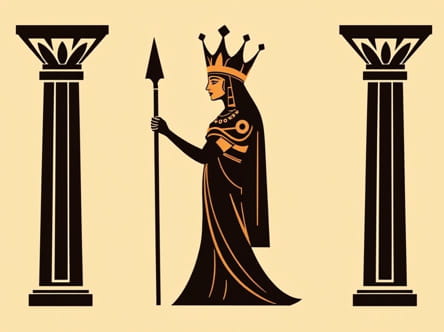
Queen Semiramis of Babylon stands as one of the most enigmatic and powerful female figures in the legends of ancient Mesopotamia. Often shrouded in myth and mystery, Semiramis is believed to have ruled Babylon with intelligence, charisma, and strategic prowess. Her story blends historical facts with legends passed down through generations, making it difficult to separate the truth from the myth. Nevertheless, her name has endured in both Eastern and Western traditions, symbolizing female power, beauty, and ambition. Whether seen as a historical queen or a legendary goddess-like figure, Semiramis remains a key figure in discussions of ancient Babylonian history and the role of women in early civilizations.
Origins and Early Life
According to various traditions, Queen Semiramis was born in the ancient city of Ashkelon, possibly of divine or semi-divine descent. Some legends claim she was the daughter of the fish-goddess Atargatis and a mortal man, while others describe her as a gifted and intelligent orphan raised by doves. These mythical elements suggest that her identity may have roots in religious and symbolic storytelling, blending human traits with divine attributes.
Semiramis eventually became the wife of Ninus, the legendary founder of Nineveh and the Assyrian Empire. When Ninus died, she assumed control of the empire, either as regent or sovereign. This transition of power is one of the earliest examples of a woman ascending to the throne in a patriarchal society, marking her as a unique figure in ancient leadership.
The Reign of Semiramis
Expansion of the Babylonian Empire
Queen Semiramis is credited with expanding the empire across much of the ancient Near East. Legends say she led military campaigns as far as India and Ethiopia, demonstrating her abilities as a military strategist. Whether these conquests are literal or symbolic remains debated, but they reflect her reputation as a ruler of global ambition.
- She allegedly commanded an army of over three hundred thousand soldiers.
- She was said to have built fortresses and roads to consolidate her rule.
- Some sources suggest she established trading networks with distant lands.
These tales emphasize her capability not just as a ruler but as a warrior queen a role rarely seen in ancient records.
Architectural Achievements
One of the most enduring legends about Queen Semiramis is her role in constructing monumental buildings in Babylon. She is often credited with building or inspiring the Hanging Gardens of Babylon, one of the Seven Wonders of the Ancient World. While historians believe the gardens may have been built later under King Nebuchadnezzar II, the association with Semiramis reflects her lasting legacy as a cultural icon.
Other architectural feats attributed to her include:
- The fortification walls of Babylon, said to be strong enough to resist any attack.
- Bridges and canals that improved irrigation and connected distant parts of the empire.
- Temples and palaces that displayed both wealth and devotion to the gods.
These constructions not only enhanced the city’s infrastructure but also solidified her image as a builder of civilizations.
Semiramis in Myth and Literature
Classical References
Ancient Greek and Roman writers, such as Diodorus Siculus, Herodotus, and Plutarch, wrote extensively about Semiramis. While some portrayed her as a wise and capable ruler, others focused on her rumored promiscuity and cruelty perhaps influenced by gender biases of the time. She was described as seductive, manipulative, and even morally dangerous, reflecting the anxieties ancient writers held about powerful women.
Despite these conflicting depictions, Semiramis captured the imagination of poets, playwrights, and historians alike. Her legend influenced later depictions of royal women in both historical texts and fictional narratives.
Semiramis in Religious Traditions
In later centuries, especially in Christian and anti-pagan narratives, Semiramis became associated with the origins of idolatry and false religion. Some 18th and 19th-century writers claimed she was the mother of Tammuz and the originator of goddess worship in Babylon. These ideas, though widely discredited by scholars today, shaped her image in religious polemics.
Nonetheless, her presence in such narratives underlines how enduring and flexible her story has been across cultures and epochs.
Legacy of Queen Semiramis
A Symbol of Female Authority
Regardless of the factual accuracy of her story, Queen Semiramis represents one of the earliest examples of a woman exercising supreme political power. Her reign, real or imagined, challenges the notion that leadership in antiquity was exclusively male. She serves as a historical model for female authority and resilience.
Influence on Later Rulers
Semiramis’s legacy can be seen in how later queens and empresses were portrayed. Rulers such as Cleopatra of Egypt, Empress Wu Zetian of China, and Catherine the Great of Russia echoed the blend of political strength and mythic storytelling that surrounded Semiramis.
Her story was often used to justify or challenge the legitimacy of powerful female rulers, depending on the agenda of the narrator. She became a metaphor for both imperial ambition and moral complexity.
Modern Interpretations
Today, historians and archaeologists continue to debate the historical existence of Queen Semiramis. Some believe she may be based on Shammuramat, an Assyrian queen who ruled as regent for her young son in the 9th century BCE. Shammuramat’s accomplishments and influence could have inspired the later legends surrounding Semiramis.
In modern culture, she remains a fascinating figure, appearing in novels, films, and historical reinterpretations. Her blend of legend and reality makes her a compelling subject for anyone interested in ancient civilizations, female leadership, and myth-making.
Queen Semiramis of Babylon continues to captivate imaginations as a ruler of immense power, visionary ambition, and complex legacy. Whether she was a historical queen, a symbolic figure, or a mixture of both, her influence on ancient and modern narratives is undeniable. Her name endures as a reminder of the richness of Mesopotamian culture and the timeless appeal of stories that elevate women to the highest seats of power. As interest in ancient history and female sovereignty grows, so too does the relevance of Semiramis a queen who ruled with a legendary hand over the heart of an empire.